

Introduction
Understanding how to manage cloud costs efficiently has become a critical engineering discipline across the industry. The Certified FinOps Architect program is designed to bridge the gap between engineering, finance, and business operations. This guide is crafted to help technical professionals navigate cloud financial management and understand the structural pathways available through FinOpsSchool. This comprehensive overview is meant for engineers, platform architects, and technology leaders who want to master cloud unit economics. It positions the certification within the broader landscape of modern cloud-native ecosystems, platform engineering, and site reliability practices. By reading this guide, you will gain clarity on whether this certification aligns with your career trajectory. It will help you make an informed decision on investing your time and effort to build sustainable and cost-effective cloud architectures.
What is the Certified FinOps Architect?
The Certified FinOps Architect represents a formal validation of an engineer’s ability to design, implement, and manage cost-optimized cloud infrastructure. It exists because organizations are heavily overspending on cloud resources due to a lack of architectural foresight and financial accountability.
This certification focuses heavily on real-world, production-ready methodologies rather than theoretical definitions. It teaches practitioners how to implement showback and chargeback models, optimize resource provisioning, and automate waste reduction.
It aligns seamlessly with modern DevOps and SRE workflows by integrating financial metrics directly into the continuous integration and continuous deployment pipelines. The certification ensures that engineers treat cost as a primary metric, just like performance and reliability, when designing enterprise systems.
Who Should Pursue Certified FinOps Architect?
This certification brings massive value to software engineers, platform developers, and infrastructure specialists who provision cloud resources. Site Reliability Engineers and DevOps professionals will find it crucial for balancing system uptime with operational expenditure.
Cloud architects and security engineers who design large-scale environments will learn how to integrate financial guardrails without stifling developer velocity. Data professionals managing massive pipelines can utilize these skills to optimize compute and storage costs associated with big data workloads.
Both beginners looking to stand out in the job market and seasoned managers directing large teams will benefit significantly. It holds tremendous relevance globally and in the rapidly growing Indian tech sector, where enterprise cost optimization is currently a massive priority.
Why Certified FinOps Architect
The demand for professionals who understand cloud economics has skyrocketed as companies look to tighten their IT budgets. Cloud migration is no longer just about moving workloads; it is about operating them efficiently, making this expertise highly sought after.
This certification offers exceptional longevity because the core principles of cost optimization remain applicable regardless of which specific tools or cloud providers dominate the market. It equips professionals with an architectural mindset that outlasts temporary technological trends.
Enterprise adoption of these financial practices is accelerating rapidly across all industry verticals. Investing time into this certification yields a high return on investment, securing your position as a strategic asset within any engineering organization.
Certified FinOps Architect Certification Overview
The program is delivered via the official Certified FinOps Architect platform and hosted on FinOpsSchool. It is designed to evaluate candidates on practical implementation rather than just multiple-choice memorization.
The certification spans multiple levels of expertise to accommodate practitioners at different stages of their careers. Assessment approaches rely heavily on real-world scenarios, architectural diagramming, and cost analysis simulations.
The structure ensures that successful candidates can immediately apply their knowledge to their company’s production environments. Ownership of this credential signals to employers that you possess both technical depth and business acumen.
Certified FinOps Architect Certification Tracks & Levels
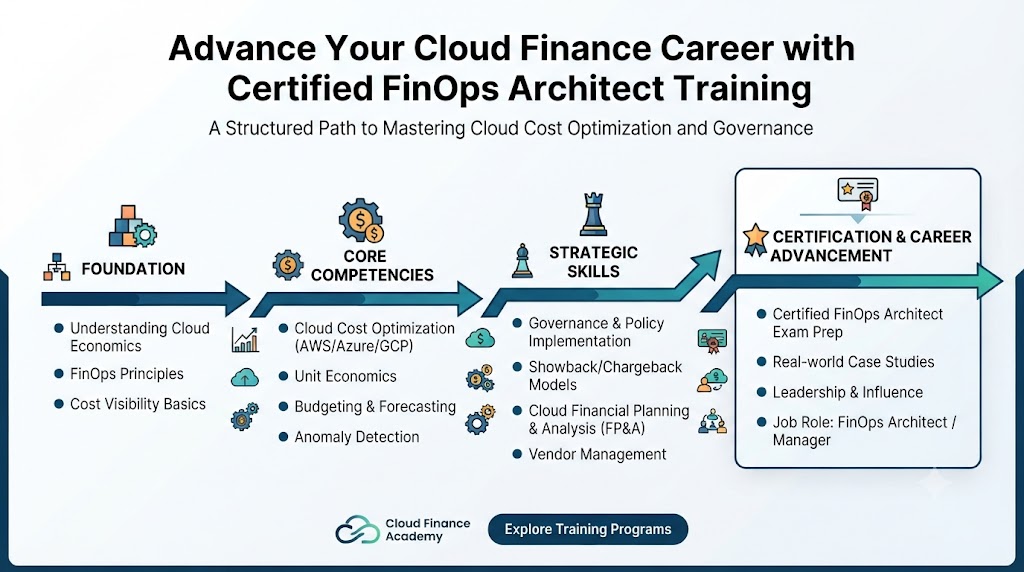
The certification is structured into progressive tiers: Foundation, Professional, and Advanced levels. The Foundation tier establishes the core vocabulary and basic mechanics of cloud billing and resource tagging.
The Professional tier delves deep into optimization strategies, advanced reservation models, and integrating cost checks into CI/CD pipelines. The Advanced tier focuses on organizational transformation, multi-cloud financial strategy, and executive reporting.
Specialization tracks exist to tailor the knowledge toward specific domains like SRE, Platform Engineering, and Data Operations. This tiered approach allows professionals to map their learning journey directly to their current job responsibilities and future career goals.
Complete Certified FinOps Architect Certification Table
| Track | Level | Who it’s for | Prerequisites | Skills Covered | Recommended Order |
| Core | Foundation | Junior Engineers, Analysts | Basic Cloud Knowledge | Tagging, Billing Basics, Waste Identification | 1 |
| Core | Professional | Cloud Engineers, DevOps, SRE | Foundation Level | CI/CD Cost Integration, Right-sizing, RIs | 2 |
| Core | Advanced | Principal Architects, Managers | Professional Level | Multi-cloud Strategy, Culture Shift, KPIs | 3 |
| Specialization | FinOps for SRE | Reliability Engineers | Foundation Level | Error Budgets vs Cost, Auto-scaling Limits | 4 |
| Specialization | FinOps for Data | Data Engineers | Foundation Level | Storage Lifecycle, Query Optimization | 4 |
Detailed Guide for Each Certified FinOps Architect Certification
Certified FinOps Architect – Foundation
What it is
This certification validates a foundational understanding of cloud financial management principles. It ensures the candidate understands core concepts like visibility, allocation, and basic cost optimization.
Who should take it
Junior engineers, financial analysts, and project managers working in cloud environments. It is ideal for those who need to understand cloud billing and terminology without deep technical implementation.
Skills you’ll gain
- Understanding of cloud pricing models and billing constructs.
- Ability to implement basic tagging and resource allocation strategies.
- Skills to identify unattached or idle cloud resources.
- Knowledge of fundamental reporting and dashboard creation.
Real-world projects you should be able to do
- Create a standardized tagging policy for a multi-team environment.
- Build a basic dashboard showing monthly cloud spend by department.
- Identify and terminate orphaned cloud storage volumes.
Preparation plan
For a 7 to 14-day plan, focus strictly on understanding the core terminology and reviewing cloud billing consoles. A 30-day plan should include hands-on practice with tagging and basic report generation. The 60-day plan allows for deep study of diverse cloud provider pricing models and organizational alignment strategies.
Common mistakes
- Focusing too much on a single cloud provider’s proprietary tools.
- Ignoring the cultural aspect of financial accountability.
- Rushing through foundational definitions without understanding their business impact.
Best next certification after this
- Same-track option: Certified FinOps Architect – Professional.
- Cross-track option: A standard DevOps or Cloud Practitioner certification.
- Leadership option: Agile or Engineering Management foundational training.
Certified FinOps Architect – Professional
What it is
This certification proves the ability to engineer and automate cost optimization directly into the infrastructure lifecycle. It validates technical depth in continuous optimization and infrastructure as code governance.
Who should take it
Mid-level to senior cloud engineers, DevOps practitioners, and platform engineers. It is designed for those who actually build, scale, and maintain cloud environments.
Skills you’ll gain
- Automation of resource scheduling and right-sizing.
- Integration of cost estimation tools within CI/CD pipelines.
- Advanced usage of Reserved Instances and Savings Plans.
- Development of automated chargeback and showback reporting.
Real-world projects you should be able to do
- Implement pipeline blocks that fail deployments if cost limits are exceeded.
- Design a fully automated reserved instance purchasing recommendation engine.
- Architect a serverless infrastructure refactoring plan to reduce compute costs.
Preparation plan
A 7 to 14-day sprint requires you to already possess deep cloud engineering experience, focusing only on the financial frameworks. A 30-day strategy involves deploying sample applications and writing infrastructure as code to manage their costs. A 60-day plan should include comprehensive testing of cost-monitoring tools in a sandbox environment.
Common mistakes
- Failing to understand the technical limitations of auto-scaling groups.
- Over-committing to long-term reservations without analyzing workload volatility.
- Treating cost optimization as an afterthought rather than a design principle.
Best next certification after this
- Same-track option: Certified FinOps Architect – Advanced.
- Cross-track option: Security or SRE-focused certifications.
- Leadership option: Cloud Architecture or Enterprise Strategy certifications.
Certified FinOps Architect – Advanced
What it is
This level validates mastery in aligning enterprise business objectives with cloud technical execution. It focuses heavily on multi-cloud economics, cultural transformation, and high-level architectural design.
Who should take it
Principal engineers, cloud architects, directors of engineering, and chief technology officers. It is aimed at leaders who dictate technical strategy across large organizations.
Skills you’ll gain
- Developing multi-cloud financial strategies and avoiding vendor lock-in costs.
- Establishing engineering cultures centered around financial accountability.
- Designing highly complex, globally distributed, cost-optimized architectures.
- Forecasting and capacity planning at the enterprise level.
Real-world projects you should be able to do
- Lead a massive cloud migration project with guaranteed cost efficiency metrics.
- Design an enterprise-wide unit economic model (e.g., cost per transaction).
- Negotiate enterprise discount programs with major cloud providers using data.
Preparation plan
A 7 to 14-day plan is only feasible for active principal architects who need to formalize their existing knowledge. A 30-day plan requires studying complex enterprise case studies and multi-cloud architectural patterns. The 60-day plan involves mapping out total organizational transformations and building comprehensive financial operating models.
Common mistakes
- Approaching the exam with a purely technical mindset, ignoring the business strategy.
- Underestimating the difficulty of driving cultural change across engineering teams.
- Relying on generic best practices instead of data-driven unit economics.
Best next certification after this
- Same-track option: Deep specialization in specific FinOps domains (e.g., Data Ops).
- Cross-track option: Advanced Cloud Security or Machine Learning architectures.
- Leadership option: Executive leadership or IT Service Management mastery.
Choose Your Learning Path
DevOps Path
The DevOps path focuses on integrating cost management directly into software delivery. Practitioners learn to utilize tools that estimate infrastructure costs during the pull request phase. This path ensures that development teams have immediate visibility into the financial impact of their code changes. It is crucial for shifting cost responsibility left in the development cycle.
DevSecOps Path
This path merges financial operations with security and compliance mandates. Engineers learn how to optimize the costs of robust security tools like vulnerability scanners and centralized logging. It emphasizes finding the right balance between necessary security expenditure and overall cloud efficiency. The goal is to build secure architectures that do not unnecessarily bloat the budget.
SRE Path
The Site Reliability Engineering path ties system reliability metrics to cloud costs. Professionals learn to evaluate whether the cost of adding extra nines of availability is justified by business needs. It involves calculating the exact cost of incident response and downtime versus preventative infrastructure scaling. This path teaches engineers how to manage error budgets alongside financial budgets.
AIOps Path
This path focuses on utilizing artificial intelligence to automate cost anomaly detection and remediation. Practitioners learn to deploy machine learning models that predict cloud usage spikes and scale resources proactively. It covers the reduction of operational overhead by automating routine financial reporting and optimization tasks. Engineers will design self-healing architectures that also self-optimize for cost.
MLOps Path
The MLOps path targets the massive compute and storage costs associated with training and serving machine learning models. Engineers learn to architect cost-effective GPU clusters and utilize spot instances for model training. It emphasizes managing the lifecycle of massive datasets without incurring runaway storage fees. This path is vital for AI-driven companies looking to maintain profitable unit economics.
DataOps Path
Data pipelines are notorious for generating hidden cloud costs. This path teaches professionals how to optimize data warehousing, ETL processes, and analytical querying. Engineers will learn to balance the performance of real-time data streaming with the cost-efficiency of batch processing. It focuses heavily on data lifecycle management and automated archival strategies.
FinOps Path
This is the core path dedicated purely to cloud financial management across the entire enterprise. It is designed for practitioners who act as the central bridge between engineering and finance. The focus is on implementing chargeback models, negotiating enterprise agreements, and driving a culture of cost awareness. This path creates dedicated specialists who own the cloud cost optimization strategy.
Role → Recommended Certified FinOps Architect Certifications
| Role | Recommended Certifications |
| DevOps Engineer | Foundation, Professional |
| SRE | Professional, FinOps for SRE |
| Platform Engineer | Professional, Advanced |
| Cloud Engineer | Foundation, Professional |
| Security Engineer | Foundation, DevSecOps Path |
| Data Engineer | Professional, FinOps for Data |
| FinOps Practitioner | Foundation, Professional, Advanced |
| Engineering Manager | Foundation, Advanced |
Next Certifications to Take After Certified FinOps Architect
Same Track Progression
For those who want to remain deeply specialized, progressing through all levels of the core track is the best approach. Moving from Professional to Advanced ensures you transition from a hands-on engineer to a strategic architect. Further specialization into specific domains like DataOps or SRE financial management will solidify your expertise. Deep specialization makes you an indispensable subject matter expert within large enterprises.
Cross-Track Expansion
If you want to broaden your engineering perspective, moving into related disciplines is highly effective. Taking certifications in advanced cloud security or site reliability engineering will complement your financial knowledge. This cross-pollination of skills allows you to design architectures that are secure, reliable, and cost-effective simultaneously. It builds a robust profile suitable for distinguished engineering roles.
Leadership & Management Track
For practitioners aiming for management, transitioning toward leadership certifications is the natural next step. Focus on credentials related to enterprise architecture, agile team management, or technology strategy. Understanding cloud economics gives you a massive advantage when managing departmental budgets and demonstrating ROI to executives. This track prepares you for roles like Director of Engineering or CTO.
Training & Certification Support Providers for Certified FinOps Architect
DevOpsSchool
DevOpsSchool provides comprehensive training designed to bridge the gap between traditional operations and modern automation practices. Their curriculum focuses heavily on real-world projects, ensuring that candidates do not just memorize concepts but actually build functional pipelines. With a strong emphasis on continuous integration and delivery, they help engineers understand where cloud costs originate during the software lifecycle. Their training integrates practical cost-management techniques directly into standard DevOps workflows. This makes it an excellent choice for engineers who want to learn how to enforce financial guardrails without slowing down release velocity.
Cotocus
Cotocus excels in providing high-level consulting and corporate training for enterprise technology transformations. Their approach to training is deeply rooted in solving complex organizational challenges rather than just passing an exam. They focus on how to align engineering teams with business objectives, making their courses highly valuable for architects and managers. Cotocus provides deep insights into multi-cloud strategies and enterprise-wide financial operating models. Their training programs are structured to help leadership teams drive cultural shifts, ensuring that cost optimization becomes a shared responsibility across all engineering departments.
Scmgalaxy
Scmgalaxy is a highly community-driven platform that offers extensive resources for continuous delivery and configuration management. They focus on the granular details of infrastructure as code and automated deployments. Their training modules are packed with hands-on labs, tutorials, and practical troubleshooting scenarios. For professionals looking to understand the financial impact of every line of deployment code, Scmgalaxy provides the necessary technical depth. They excel at teaching engineers how to write efficient code that provisions only the cloud resources absolutely required for production workloads.
BestDevOps
BestDevOps serves as a curated hub for industry standards, best practices, and high-quality learning resources. They aggregate the most effective methodologies for running reliable and cost-efficient cloud operations. Their training materials are designed to provide clear, actionable insights that can be implemented immediately in a workplace environment. BestDevOps focuses on standardization, teaching professionals how to enforce tagging policies and compliance checks globally. Their approach ensures that learners understand how to maintain clean, optimized, and financially transparent cloud architectures over the long term.
devsecopsschool.com
This provider focuses on the critical intersection of security, operations, and development. Their training emphasizes the shift-left security paradigm, teaching engineers how to secure infrastructure early in the lifecycle. They highlight the financial impact of security decisions, helping practitioners avoid costly compliance breaches and over-provisioned security appliances. Their courses show how to balance rigorous security requirements with optimal cloud expenditure. It is the perfect training ground for engineers who need to design environments that are both financially lean and hardened against modern cyber threats.
sreschool.com
Sreschool.com is dedicated to the discipline of Site Reliability Engineering and system observability. Their training focuses heavily on defining Service Level Indicators, Objectives, and Agreements. They teach practitioners how to correlate system reliability with infrastructure costs effectively. Engineers learn the financial cost of chasing total availability and how to design systems that degrade gracefully without breaking the bank. Their curriculum is highly analytical, making it ideal for professionals who need to manage error budgets alongside their actual cloud financial budgets.
aiopsschool.com
This platform specializes in the rapidly evolving field of Artificial Intelligence for IT Operations. Their training covers how to deploy machine learning algorithms to automate incident resolution and system optimization. They teach engineers how to build intelligent systems that can automatically detect cloud billing anomalies and correct them without human intervention. Their courses dive deep into predictive scaling and automated waste reduction. It is a highly advanced training provider suited for engineers looking to push the boundaries of automated cloud financial management.
dataopsschool.com
Dataopsschool.com focuses exclusively on the engineering practices required to manage massive data pipelines and analytics infrastructure. Their training highlights the massive hidden costs associated with data transfer, storage, and inefficient querying. They teach practitioners how to optimize data warehouses, implement effective data lifecycle policies, and streamline ETL jobs. The curriculum provides deep technical strategies for managing big data architectures without incurring astronomical cloud bills. This is essential training for data engineers operating at an enterprise scale.
finopsschool.com
FinOpsSchool is the premier destination dedicated entirely to cloud financial management and operational efficiency. Their training covers the complete spectrum of cost allocation, anomaly detection, and enterprise unit economics. They provide deep, domain-specific knowledge on how to bridge the gap between technical engineering execution and financial business strategy. Their courses are built on real-world enterprise case studies and practical cloud optimization scenarios. This provider is the definitive resource for anyone looking to master the financial aspects of modern cloud-native architectures.
Frequently Asked Questions
1. What is the main objective of this certification?
The primary objective is to validate an engineer’s ability to design, implement, and maintain cost-optimized cloud infrastructure. It ensures you understand how to align technical architecture with business financial goals. The focus is always on practical, real-world application rather than abstract theories.
2. How much technical experience is required?
While the Foundation level requires basic cloud familiarity, the Professional and Advanced levels require active engineering experience. You should be comfortable with cloud consoles, basic architecture design, and modern deployment methodologies. Hands-on experience with infrastructure as code is highly recommended for higher tiers.
3. Does this certification expire?
Yes, like most technology certifications, it typically requires renewal every two to three years. This ensures that credential holders stay updated with the rapidly changing cloud billing models and optimization tools. Renewal usually involves passing a recertification exam or earning continuing education credits.
4. Can I skip the Foundation level and jump to Advanced?
It is generally not recommended to skip levels unless you have extensive, provable experience in cloud financial management. The Foundation level establishes critical vocabulary and concepts that the higher levels build upon. Following the standard progression ensures no knowledge gaps.
5. How long does it take to prepare for the exam?
Preparation time varies based on your existing experience. A seasoned cloud engineer might need only 14 to 30 days of focused study. Beginners or those transitioning from non-technical roles should expect to spend 60 to 90 days preparing for the Foundation level.
6. Is this certification vendor-neutral?
The core principles taught in the certification apply across all major cloud providers. While you will learn concepts that translate to AWS, Azure, and GCP, the focus is on the underlying architectural strategies. This vendor-neutral approach makes the knowledge highly transferable.
7. Are there any hands-on labs required?
Advanced levels of the certification process heavily emphasize practical application. You will likely be tested on your ability to analyze billing data, design optimization strategies, and troubleshoot architecture setups. Practical, hands-on experience is critical for passing the higher-tier exams.
8. Will this certification help me get a job?
Yes, cloud cost optimization is a massive priority for enterprises today. Having this credential on your resume immediately signals to employers that you can save them money while building robust systems. It heavily differentiates you from standard cloud engineers.
9. What happens if I fail the exam?
Most certification bodies offer a retake policy, often with a mandatory waiting period between attempts. It is advised to carefully review the score report to identify weak areas. Utilize the waiting period to engage in deeper hands-on practice before retaking.
10. Do I need to know how to code?
For the Foundation level, deep programming knowledge is not strictly necessary. However, for the Professional and Advanced levels, you must understand infrastructure as code and basic scripting. Automating cost controls requires the ability to read and write deployment configurations.
11. Is the exam multiple-choice or practical?
The Foundation level typically utilizes multiple-choice questions to test core knowledge. Higher levels often incorporate scenario-based questions, architecture evaluations, and sometimes practical lab environments. The difficulty scales significantly as you progress through the tracks.
12. Can managers benefit from this certification?
Absolutely. Engineering managers and directors benefit massively from understanding unit economics and cloud billing mechanisms. It allows them to accurately forecast budgets, negotiate with vendors, and lead their teams toward more efficient architectural decisions.
FAQs on Certified FinOps Architect
1. How does the Certified FinOps Architect differ from standard cloud certifications?
Standard cloud certifications focus primarily on how to build, deploy, and secure services within a specific provider’s ecosystem. The Certified FinOps Architect specifically targets the financial implications of those architectural choices. It teaches you not just how to build a highly available system, but how to build it cost-effectively. The focus shifts from purely technical metrics to business metrics like unit economics, return on investment, and automated cost avoidance. It bridges the gap between the engineering team deploying the code and the finance team paying the monthly cloud bill.
2. How does this certification address multi-cloud environments?
Managing costs across multiple cloud providers is exceptionally difficult due to differing pricing models, discount structures, and billing formats. This certification provides standard frameworks to normalize billing data across AWS, Azure, and GCP. It teaches architects how to avoid vendor lock-in penalties and how to leverage multi-cloud strategies for financial leverage rather than just redundancy. You learn how to build centralized dashboards that give leadership a single pane of glass into organizational spending, regardless of where the workloads are actually hosted. This is critical for modern enterprise architectures.
3. What is the concept of unit economics covered in the exam?
Unit economics involves shifting the conversation from “how much does our cloud cost?” to “how much does it cost to serve one customer?” This certification teaches engineers how to correlate cloud spend directly to business metrics. For example, calculating the exact infrastructure cost to process a single e-commerce transaction. By mastering this, architects can prove to business leaders that rising cloud costs are acceptable if they are driven by proportional user growth. It moves cloud infrastructure from being viewed as a pure cost center to a scalable business driver.
4. Does the curriculum cover containerized workloads and Kubernetes?
Yes, containerized environments like Kubernetes present unique challenges for cost allocation because multiple teams often share the same underlying compute clusters. The certification covers advanced strategies for tracking resource utilization at the pod and namespace level. It teaches engineers how to implement chargeback models in shared environments and how to optimize container sizing to prevent resource hoarding. You will learn how to configure autoscaling efficiently so that you are not paying for massive amounts of idle cluster capacity during off-peak hours.
5. How important is the cultural aspect taught in this certification?
The technical implementation of cost optimization is often easier than changing the engineering culture. This certification places a heavy emphasis on organizational alignment. It teaches architects how to create blameless environments where developers care about the cost of their code. You will learn how to set up gamification, internal reporting, and financial guardrails that guide developers without slowing down their daily workflows. The most successful cloud architectures are built by teams who inherently treat cost as a primary design constraint from day one.
6. Will this certification teach me how to negotiate with cloud vendors?
At the Advanced level, the curriculum delves into enterprise agreements, discount programs, and strategic vendor negotiations. It provides architects with the data-driven methodologies needed to analyze historical usage and accurately forecast future capacity needs. Armed with this data, professionals can confidently negotiate custom pricing models, massive reserved instance purchases, and specific enterprise discount plans with major cloud providers. It elevates the architect from a purely technical role to a strategic business advisor who can secure millions of dollars in savings for the enterprise.
7. How does automation play a role in the skills taught?
Manual cost optimization is impossible at an enterprise scale. The certification heavily emphasizes the automation of financial controls. It teaches engineers how to write scripts and utilize tools that automatically identify and terminate unattached storage volumes, idle load balancers, and unused compute instances. Furthermore, it covers how to automate the purchasing of dynamic capacity like Spot instances and how to integrate cost estimation tools directly into the CI/CD pipeline. The goal is to make cost efficiency a continuous, automated process rather than a monthly manual review.
8. What role do Reserved Instances and Savings Plans play in the curriculum?
Understanding commitment-based discounts is a massive component of the certification. It teaches the mathematical and strategic differences between standard reservations, convertible reservations, and flexible savings plans. Practitioners learn how to analyze their baseline workloads to make confident, long-term financial commitments without risking unused capacity. The curriculum covers strategies for blending on-demand pricing with spot instances and savings plans to achieve the lowest possible compute cost while maintaining system reliability. It is a critical skill for drastically reducing the largest portion of any cloud bill.
Final Thoughts: Is Certified FinOps Architect Worth It?
Investing time and effort into the Certified FinOps Architect path is one of the most strategic career moves a modern technology professional can make. The era of unchecked cloud spending has ended, and enterprises are now demanding strict financial accountability alongside technical excellence. Earning this credential proves that you possess the rare ability to build robust, highly scalable systems without bleeding capital.
The value lies not just in learning how to read a billing console, but in acquiring an architectural mindset that treats cost as a first-class engineering metric. Whether you are a hands-on engineer configuring autoscaling groups or a strategic leader negotiating enterprise contracts, these skills will keep you highly relevant in the industry. It empowers you to bridge the historical divide between engineering and finance, making you an indispensable asset to any organization navigating the complexities of modern cloud infrastructure.