

Introduction
Managing cloud expenditure has transformed from an administrative task into a crucial engineering challenge. The Certified FinOps Engineer qualification provides systems leads, platform specialists, and operations managers with the technical capabilities needed to tie architectural choices directly to financial outcomes. As enterprises expand across public and private clouds, balancing compute performance with spending efficiency has become a defining skill for modern technical professionals. This guide offers a clear breakdown of the Certified FinOps Engineer path, detailing its core concepts, practical applications, and strategic career progression.
What is the Certified FinOps Engineer?
The Certified FinOps Engineer credential is a targeted technical framework designed to unify system engineering, cloud operations, and financial governance. Rather than focusing solely on server provisioning or high availability design, this program centers on cloud financial management, precise cost attribution, unit economics, and automated policy enforcement.
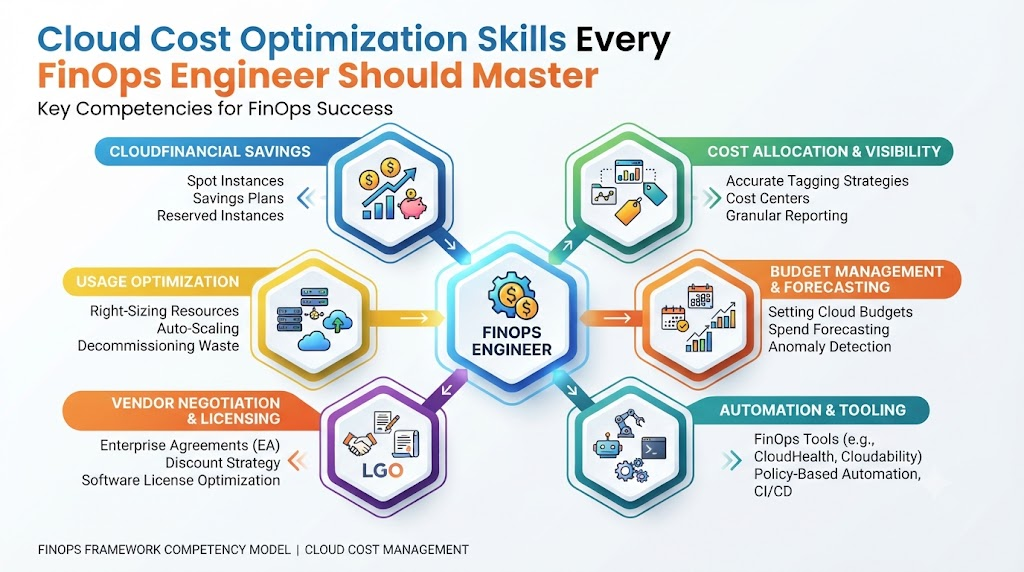
It delivers the practical tools required to build cost-conscious cloud platforms. Candidates learn to parse complex usage data, establish consistent tagging models, implement automated anomaly detection, and optimize compute workloads across multi-cloud setups. It creates a shared operational language between engineering teams, platform leads, and executive management.
Who Should Pursue Certified FinOps Engineer?
This credential is built for technical professionals who design, deploy, or govern cloud systems. Platform engineers, SREs, DevOps specialists, and cloud architects responsible for cost visibility within CI/CD pipelines and infrastructure workflows will find immediate practical value.
Financial analysts, product leads, and engineering directors managing cloud operational budgets also benefit from learning the underlying technical mechanics of cloud spending. Whether you are an engineer looking to enhance your skill set or a manager tasked with eliminating cloud waste, this certification provides actionable insights relevant across global markets and India’s growing tech hubs.
Why Certified FinOps Engineer
Cloud infrastructure represents a major recurring expense for modern digital enterprises. Left unmonitored, idle instances and unoptimized architectures can quickly reduce operating margins. Maintaining cost control without slowing down development speed or platform reliability is a top business priority.
Earning the Certified FinOps Engineer qualification shows that you can design resilient systems while keeping resource consumption efficient. As businesses move from reactive cost-cutting to proactive financial engineering, certified professionals remain essential strategic assets with strong long-term career growth.
Certified FinOps Engineer Certification Overview
The Certified FinOps Engineer curriculum offers an end-to-end framework for mastering cloud financial management. Designed around realistic production scenarios, the assessment evaluates an engineer’s capacity to execute cost optimization strategies in active deployment environments.
The evaluation goes beyond theoretical knowledge, testing candidates on real-world tasks like container rightsizing, storage lifecycle automation, commitment model planning, and multi-tenant showback design. Maintained by industry specialists, the certification stays up to date with modern billing formats, governance protocols, and cloud-native cost tooling.
Certified FinOps Engineer Certification Tracks & Levels
The certification path is divided into progressive tiers to support professionals at different career stages. The initial tier covers essential principles, cloud billing fundamentals, and the core FinOps stages: Inform, Optimize, and Operate. Candidates build a solid understanding of cost allocation and usage reporting.
Intermediate and advanced levels focus on technical execution and system design. These tiers address automated remediation, custom telemetry for unit costs, multi-account chargeback, and policy-as-code enforcement. Specialized tracks allow professionals to focus on container cost allocation, serverless optimization, or multi-cloud governance.
Complete Certified FinOps Engineer Certification Table
| Track | Level | Who it’s for | Prerequisites | Skills Covered | Recommended Order |
| FinOps Foundation | Associate | Beginners, Analysts, Junior Engineers | Basic Cloud Knowledge | Cloud Billing Concepts, Inform-Optimize-Operate Lifecycle, Cost Allocation Basics | 1 |
| FinOps Engineering | Professional | DevOps Engineers, SREs, Cloud Architects | 1-2 Years Cloud Administration | Automated Right-Sizing, Tagging Enforcement, Commitment Planning, Anomaly Detection | 2 |
| FinOps Architecture | Advanced | Principal Architects, Technical Leads, Managers | 3+ Years Multi-Cloud Operations | Enterprise Unit Economics, Custom Telemetry, Multi-Tenant Chargeback, Policy as Code | 3 |
| Container FinOps | Specialist | Kubernetes Engineers, Platform Leads | Deep Kubernetes Experience | Pod-Level Cost Allocation, Karpenter/KEDA Auto-scaling, Resource Request Optimization | 4 |
Detailed Guide for Each Certified FinOps Engineer Certification
Certified FinOps Engineer – Foundation Level
What it is
This entry-level certification confirms your grasp of cloud cost management fundamentals, standard billing models, and the operational steps required to create financial visibility across cloud workloads.
Who should take it
Systems administrators, technology analysts, project leads, and junior engineers who want a structured introduction to cloud financial operations and resource management.
Skills you’ll gain
- Reading pricing structures across major public cloud providers
- Building standardized tagging rules for accurate cost mapping
- Using cloud vendor billing dashboards and cost analysis tools
- Creating basic showback reporting for engineering squads
Real-world projects you should be able to do
- Draft cost distribution reports grouped by team, environment, and application
- Locate unattached disks, idle compute instances, and unused IPs across cloud accounts
- Set up budget notification rules to catch spending spikes early
Preparation plan
- 7–14 days: Review core concepts around cloud billing models, pricing tiers, and FinOps phases.
- 30 days: Perform practical exercises inside cloud billing consoles to configure custom tagging views.
- 60 days: Run a mock cost audit on a test cloud account and build custom spending dashboards.
Common mistakes
- Viewing FinOps as purely a finance responsibility instead of an engineering mindset
- Missing hidden charges like cross-region traffic and network egress fees
- Focusing only on vendor discounts while ignoring wasteful resource usage
Best next certification after this
- Same-track option: Certified FinOps Engineer – Professional Level
- Cross-track option: Certified DevOps Engineer
- Leadership option: Certified Cloud Engineering Manager
Certified FinOps Engineer – Professional Level
What it is
This certification confirms your ability to run automated cost optimizations, build governance policies, and manage discount commitments across multi-cloud platforms.
Who should take it
DevOps specialists, Site Reliability Engineers, platform leads, and cloud admins actively managing production environments.
Skills you’ll gain
- Writing automated scripts to clear out abandoned cloud assets
- Planning discount commitments including Savings Plans and Reserved Capacity
- Applying Policy-as-Code to force tagging compliance and instance limits
- Setting up real-time anomaly alerts connected to team chat tools
Real-world projects you should be able to do
- Build a serverless job that detects and stops non-compliant sandbox environments automatically
- Set up container resource tuning based on real historical CPU and memory metrics
- Construct a unified multi-cloud billing pipeline that aggregates data into a queryable warehouse
Preparation plan
- 7–14 days: Study cloud billing APIs, usage report schemas, and policy enforcement tools.
- 30 days: Build automated rightsizing pipelines and practice calculating commitment coverage.
- 60 days: Deploy an automated governance framework across a multi-account lab environment.
Common mistakes
- Buying long-term compute commitments without evaluating application traffic variations
- Downsizing servers aggressively without reviewing application performance baselines
- Depending on manual checkups instead of setting up automated enforcement rules
Best next certification after this
- Same-track option: Certified FinOps Engineer – Advanced Level
- Cross-track option: Certified Platform Engineer
- Leadership option: Director of Infrastructure & Cloud Operations
Certified FinOps Engineer – Advanced Level
What it is
This advanced credential validates your ability to design enterprise-wide financial frameworks, custom metrics pipelines, and business unit cost models.
Who should take it
Principal engineers, enterprise architects, and senior FinOps leaders overseeing large cloud budgets and cross-team operational policies.
Skills you’ll gain
- Designing multi-tenant chargeback models with custom usage tracking
- Defining unit economic metrics that tie infrastructure spend directly to business transactions
- Leading cross-functional working groups to build a culture of cost accountability
- Embedding cost controls directly into developer platforms and IaC code repositories
Real-world projects you should be able to do
- Create a telemetry pipeline that tracks cost-per-user across microservice workloads
- Set up global multi-cloud guardrails that check deployment costs directly inside CI/CD pipelines
- Build financial forecasting models using planned application changes and business growth projections
Preparation plan
- 7–14 days: Review enterprise case studies on unit economics, internal chargeback, and team adoption.
- 30 days: Build data pipelines that combine billing logs with application metrics to measure unit costs.
- 60 days: Write and roll out an enterprise FinOps operational blueprint across engineering and finance teams.
Common mistakes
- Underestimating the culture shift required to get developer teams to care about spending
- Building complicated chargeback mechanisms before getting basic cost attribution right
- Failing to connect infrastructure savings directly to broader business outcomes
Best next certification after this
- Same-track option: Container FinOps Specialist
- Cross-track option: Certified Enterprise Solution Architect
- Leadership option: Vice President of Infrastructure / CTO Leadership Track
Choose Your Learning Path
DevOps Path
The DevOps track embeds financial visibility into everyday deployment pipelines. Engineers learn to use static code checks that estimate infrastructure cost impacts before pull requests are approved. Key focus areas include Policy-as-Code, Terraform cost checks, and automated environment teardowns.
DevSecOps Path
The DevSecOps track links security compliance with cloud spend controls. Security policies and financial guardrails run side by side in build pipelines. Engineers learn to identify misconfigured, open, or over-provisioned resources that create both security risks and unnecessary costs.
SRE Path
Site Reliability Engineers learn to balance uptime, response speed, and infrastructure expenses. This track connects cost metrics to SLOs and SLIs. Engineers learn to set up spending budgets alongside reliability targets so performance fixes don’t cause unexpected budget overruns.
AIOps Path
The AIOps track uses machine learning models to monitor spending patterns and telemetry. Engineers learn to implement automated anomaly detection tools that spot unexpected billing changes instantly. This specialization helps teams predict future usage based on past traffic trends.
MLOps Path
The MLOps track addresses the high costs of training and hosting machine learning models. Engineers focus on maximizing GPU efficiency, managing distributed training clusters, and choosing efficient model deployment hardware to keep AI projects financially sustainable.
DataOps Path
DataOps specialists manage heavy data pipelines, analytical warehouses, and distributed queries. This track shows engineers how to optimize query costs, set up automated storage tiering, and track data processing expenses by team or pipeline job.
FinOps Path
The dedicated FinOps track offers complete coverage of cloud financial management, cloud economics, and organizational policy. Practitioners learn everything from basic billing structures to multi-cloud chargeback models, commitment portfolio management, and unit economics.
Role → Recommended Certified FinOps Engineer Certifications
| Role | Recommended Certifications |
| DevOps Engineer | Certified FinOps Engineer – Professional Level, Container FinOps Specialist |
| SRE | Certified FinOps Engineer – Professional Level, Performance & Efficiency Specialist |
| Platform Engineer | Certified FinOps Engineer – Advanced Level, Container FinOps Specialist |
| Cloud Engineer | Certified FinOps Engineer – Foundation Level, Certified FinOps Engineer – Professional Level |
| Security Engineer | Certified FinOps Engineer – Foundation Level, Cloud Governance Specialist |
| Data Engineer | Certified FinOps Engineer – Professional Level, DataOps Cost Specialist |
| FinOps Practitioner | Certified FinOps Engineer – Foundation, Professional, and Advanced Tiers |
| Engineering Manager | Certified FinOps Engineer – Foundation Level, Executive FinOps Leadership |
Next Certifications to Take After Certified FinOps Engineer
Same Track Progression
If you want to deepen your expertise in cloud financial management, advancing through higher certification levels is a great path. Moving from associate to professional and advanced tiers builds deep capability in automated governance, custom billing data pipelines, and enterprise chargeback design. Specialized credentials in container cost allocation or serverless efficiency provide additional focus for complex setups.
Cross-Track Expansion
Combining cost management skills with other technical domains creates a highly versatile profile. Pairing FinOps certifications with platform engineering, reliability engineering, or cloud security credentials prepares you to design systems that are secure, highly available, and budget-friendly. Understanding how deployment automation affects cloud spend makes you a stronger technical lead.
Leadership & Management Track
For engineers aiming for management, following a technical FinOps certification with leadership development offers clear advantages. Understanding cloud economics gives tech leaders the ability to discuss trade-offs comfortably with financial leads and executive teams. Combining technical execution with business awareness opens doors to roles like Director of Cloud Operations, Head of Platform, or Chief Technology Officer.
Training & Certification Support Providers for Certified FinOps Engineer
The Core Platform Authority
FinOpsSchool stands as the primary technical source for cloud financial management certifications and training paths. It provides professionals with structured, practical curricula built around real-world production environments. Through interactive labs, actual billing dataset analysis, and expert instruction, candidates gain real operational capability rather than superficial concepts. The platform updates its modules regularly to cover new multi-cloud billing rules, container tuning methods, and policy automation engines.
DevOpsSchool
DevOpsSchool is a globally recognized training organization providing extensive, instructor-led courses across modern software engineering domains. Having trained thousands of technology professionals worldwide, it offers structured learning programs spanning DevOps, Cloud Architecture, FinOps, Site Reliability Engineering, and Platform Operations. Its programs focus heavily on hands-on project work, interactive lab exercises, and one-on-one mentorship to help engineers meet rigorous industry certification standards.
Cotocus
Cotocus focuses on delivering enterprise training and technology consulting designed for growing tech organizations. Their FinOps programs center on practical infrastructure automation, custom data collection pipelines, and governance policies built for scaling companies.
Scmgalaxy
Scmgalaxy is a widely used technology portal providing detailed guides, community tutorials, and technical support for configuration management, DevOps automation, and cloud cost management teams.
BestDevOps
BestDevOps delivers structured career paths, technical skill evaluations, and hands-on preparation guides for software professionals building knowledge in automation, cloud design, and cost efficiency.
devsecopsschool.com
devsecopsschool.com delivers focused education on building security and compliance controls directly into CI/CD pipelines, making sure cost guardrails and security standards run together smoothly.
sreschool.com
sreschool.com concentrates on system reliability, platform observability, and performance optimization, helping engineers maintain strong availability targets while keeping cloud infrastructure spend in check.
aiopsschool.com
aiopsschool.com provides advanced instruction on applying machine learning systems to automate platform operations, spot spending anomalies, and handle capacity planning.
dataopsschool.com
dataopsschool.com offers specialized courses on scaling, maintaining, and optimizing high-throughput data processing pipelines, cloud data warehouses, and analytics clusters efficiently.
finopsschool.com
finopsschool.com delivers dedicated technical guides, practical lab exercises, and complete certification programs for engineers, architects, and financial leads focusing on cloud cost management.
Frequently Asked Questions (General)
- What is the core goal of the Certified FinOps Engineer program?
The program aims to give engineers the skills needed to monitor, optimize, and govern cloud infrastructure spend without sacrificing system performance or development velocity. - Do I need programming experience to complete this certification?
Entry levels require minimal coding, but professional and advanced tiers benefit from working knowledge of scripting languages like Python or Bash, as well as Policy-as-Code tooling. - How much study time is recommended for the exam?
It depends on your current experience. Beginners usually need 30 to 60 days of consistent study, while active cloud engineers can prepare in 14 to 30 days. - Is this certification tied to a single cloud vendor like AWS or Azure?
No, the course is cloud-agnostic. It teaches core financial principles, universal billing concepts, and frameworks that apply across AWS, Azure, Google Cloud, and private clouds. - How is FinOps different from traditional cost management?
Traditional cost management relies on periodic, reactive cuts. FinOps builds an ongoing culture where engineering, finance, and product teams work together to make cost-aware technical decisions. - How does this credential help my career trajectory?
Certified engineers often see increased demand for platform leadership roles, improved compensation potential, and broader mobility as companies prioritize cloud cost governance. - Are there mandatory requirements before taking the foundational exam?
There are no formal prerequisites for the introductory exam, though having a general understanding of cloud computing services and IT infrastructure is recommended. - Does the examination include practical hands-on tasks?
Yes, intermediate and advanced testing levels include scenario-based questions and practical exercises to test your real-world engineering skills. - How frequently is the course material updated?
The curriculum is updated regularly to match evolving cloud pricing setups, container management platforms, and modern FinOps software. - Is this certification useful for engineering managers?
Yes, technology leaders gain the insights needed to connect technical roadmaps with financial budgets, evaluate unit metrics, and build a cost-aware engineering team. - What is the primary difference between showback and chargeback?
Showback gives teams visibility by displaying their cloud costs without deducting funds, while chargeback directly assigns and deducts cloud costs from department budgets. - How do FinOps practices fit into CI/CD pipelines?
FinOps integrates by checking cost estimates during pull requests, enforcing resource tagging through code checks, and giving developers instant feedback on resource expenses.
FAQs on Certified FinOps Engineer
- How challenging is the Certified FinOps Engineer exam for active engineers?
Difficulty depends on your experience with cloud infrastructure and billing tools. Engineers familiar with cloud setups usually grasp the core ideas quickly, but must study allocation frameworks, commitment models, and billing data structures carefully. - What technical skills are tested in the practical portion of the exam?
Candidates are tested on analyzing cloud billing files, writing cleanup scripts for unused assets, setting up tagging rules, calculating discount coverage, and configuring budget alert hooks. - Is this certification recognized by enterprise employers globally?
Yes, the certification is recognized internationally across enterprise companies, technology consultancies, and scaling startups as a solid validation of cloud financial engineering skills. - How does this certification support engineers working with Kubernetes?
Kubernetes introduces shared cluster costs that can be hard to track. This certification teaches pod-level cost allocation, efficient auto-scaling setup, and resource request tuning for container workloads. - Which tools are covered throughout the certification track?
The track covers native cloud billing consoles, open-source cost dashboards, Policy-as-Code engines, IaC cost estimation tools, and billing data processing scripts. - How does this training help engineers communicate with business executives?
It gives technical leads the vocabulary, metrics, and visualization methods needed to translate complex infrastructure operations into clear unit economic reports that executive teams can act on. - What study routine works best for professionals working full-time?
Setting aside one hour daily for 30 to 45 days is very effective. Use weekends for hands-on billing labs and weekdays for reviewing concepts and taking practice scenario quizzes. - How does the curriculum address complex multi-cloud environments?
The course teaches normalized data ingestion techniques, helping engineers convert different vendor billing formats into a unified schema for clear cross-cloud reporting.
Final Thoughts: Is Certified FinOps Engineer Worth It?
Earning the Certified FinOps Engineer qualification is a smart, career-focused step for modern infrastructure engineers and technology managers. As cloud environments expand and business budgets face closer review, the ability to build cost-efficient systems is just as important as building fast or secure ones.
This credential proves you possess both technical depth and business awareness. It moves you beyond basic infrastructure setup and positions you as a strategic team member who understands how system design impacts company performance. For engineers focused on long-term growth in DevOps, SRE, and platform engineering, mastering FinOps provides a valuable and lasting professional advantage.