

Introduction
Military strategy forms the foundation of national security planning, defense policy, and armed forces management. For researchers, students, and analysts studying defense topics on platforms like WarOpsX.com, understanding how strategy connects with broader defense studies is essential. Rather than focusing on tactical combat, strategy deals with the deployment and management of national military instruments to achieve long-term political and security objectives.
Understanding Military Strategy
At its core, military strategy is the overarching plan and application of military force to attain specific national goals. It operates above the tactical level of individual battles and the operational level of large-scale campaigns. Strategic planning requires balancing ends, ways, and means. The “ends” represent the desired political or security objectives, the “ways” describe the strategic approach or course of action, and the “means” comprise the available military capabilities, resources, and alliances. Strategic analysis requires examining how military power interacts with economic, diplomatic, and informational elements of national power. Through careful study, researchers evaluate how doctrine shapes force posture and how resource allocation impacts national readiness.
Historical Development of Strategic Thought
The evolution of strategic thought reflects changing technologies, political structures, and societal values. Early historical analysis focuses on classical campaigns, where strategy was largely constrained by geography, communication speeds, and logistical limits. Major historical transitions altered the character of warfare. The rise of mass citizen armies during the Napoleonic era transformed strategy from limited dynastic conflicts into total national mobilizations. During the industrial age, railway networks, telegraph communications, and mechanized weaponry expanded the scale of military operations. Strategists had to account for mass production, industrial capacity, and complex mobilization schedules. In the 20th century, nuclear technology and aerospace capabilities shifted strategic focus toward deterrence, alliance stability, and rapid global reach. Historical study provides context for contemporary defense challenges by illustrating how past leaders adapted doctrine to technological disruption.
Key Components of Strategic Planning
Effective defense planning relies on several interdependent components that link high-level policy to operational execution.
Doctrine and Policy Formulation
Doctrine provides the official beliefs and guiding principles that direct military forces in coordinated actions. It shapes how armed forces train, organize, and equip themselves for potential missions.
Resource Allocation and Force Structure
Strategic planners must evaluate budgetary constraints, industrial capacity, and demographic trends. Decisions regarding force structure determine whether a military maintains a standing force focused on territorial defense or a flexible expeditionary posture capable of global deployment.
Risk Management and Deterrence
A primary function of modern strategy is deterrence—dissuading potential adversaries from undertaking hostile actions through the credible threat of unacceptable costs or denial of objectives.
Military Operations and Organizational Coordination
Military strategy translates into action through structured military operations. Organizing complex campaigns requires precise coordination across multiple services, including land, air, naval, and space components. Historical campaigns demonstrate that operational success depends on clear lines of authority, disciplined communication, and unity of effort. Educational analysis of operational art focuses on how commanders sequence tactical events to achieve strategic aims while managing risks and friction.
Military Logistics and Support Systems
No strategic plan can succeed without robust military logistics. Logistics encompasses the procurement, maintenance, transportation, and medical support required to sustain armed forces during training and operations.
Throughout military history, supply chain failures have halted major campaigns far more frequently than enemy action. Modern logistics involves complex inventory management, global transportation networks, and secure supply lines. Maintaining equipment readiness and ensuring uninterrupted fuel, ammunition, and food supplies remain central concerns for defense planners.
Command and Control Systems
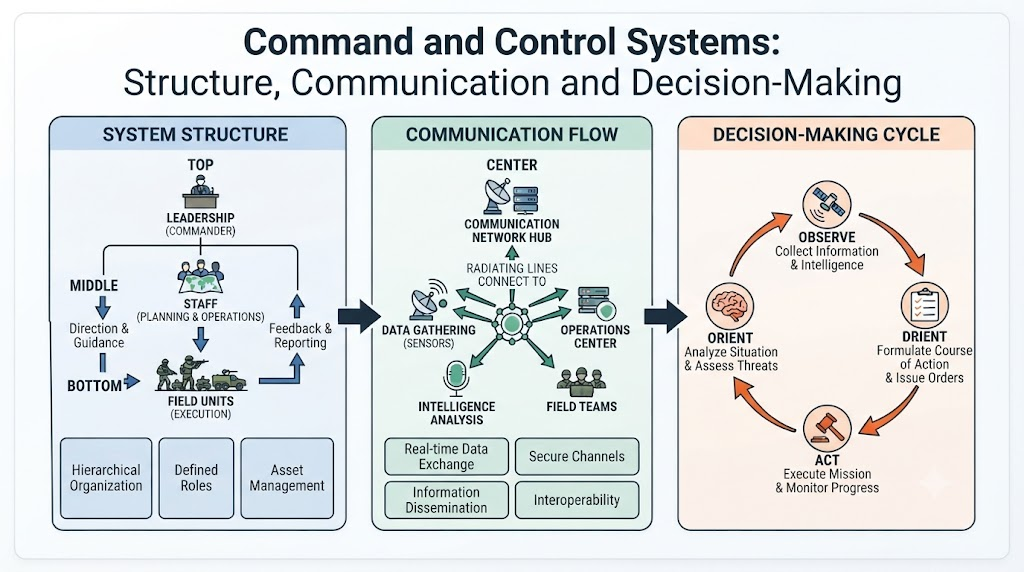
Coordinating large military organizations requires reliable Command and Control Systems. These systems combine personnel, procedures, and communication technologies to gather information, distribute orders, and monitor execution.
Effective command structures balance centralized policy control with decentralized operational execution, allowing subordinate leaders to adapt to changing conditions on the ground. Secure communication networks and data processing tools ensure that leadership maintains situational awareness during fast-moving crises.
Intelligence, Surveillance and Reconnaissance
Information gathering forms a vital pillar of strategic decision-making. Intelligence, Surveillance and Reconnaissance (ISR) operations provide the raw data and analysis needed to understand adversary capabilities, intentions, and environmental conditions.
ISR activities range from satellite observation and signals intelligence to human reporting and cyber monitoring. Processed intelligence informs strategic estimates, helps identify vulnerabilities, and supports strategic deterrence by reducing uncertainty.
Defense Technology and Modern Military Systems
Technological innovation continuously alters the character of military competition. Modern defense technology includes advanced sensors, autonomous systems, artificial intelligence data analytics, and secure communications infrastructure.
While new technologies offer enhanced precision and efficiency, they also introduce challenges related to cost, cybersecurity vulnerabilities, and electronic warfare. Defense studies evaluate how technological modernization influences tactical capabilities and strategic stability.
Military Organizational Structure
A nation’s military organizational structure dictates its internal hierarchy, administrative processes, and combat efficiency. Most modern forces feature a joint structure that integrates army, navy, and air force branches under unified leadership.
Clear organizational frameworks define chains of command, accountability, and training standards. Structural reforms often occur in response to changing geopolitical threats, budgetary pressures, or lessons learned from historical conflicts.
Multidomain Operations
Contemporary defense environments require coordination across land, air, maritime, space, and cyberspace domains. Multidomain operations seek to synchronize effects across these diverse environments simultaneously. Achieving overmatch requires seamless data sharing, cross-service cooperation, and agile planning frameworks that overcome traditional bureaucratic silos.
Comparison of Strategic and Operational Elements
| Analytical Factor | Strategic Level | Operational Level | Tactical Level |
| Primary Focus | National objectives and grand policy | Campaign design and joint coordination | Engagement execution and combat |
| Time Horizon | Long-term and multi-year planning | Medium-term campaign duration | Immediate and short-term execution |
| Key Participants | National leaders and senior military chiefs | Component commanders and staff officers | Unit commanders and personnel |
| Primary Concern | Resource allocation and deterrence | Synchronization and logistics support | Direct mission accomplishment |
Common Challenges in Defense Studies
Researchers examining military topics frequently encounter several analytical challenges:
- Complex Terminology: Navigating specialized acronyms and technical jargon requires careful study.
- Information Scarcity: Publicly available data on active military programs or classified capabilities is often limited.
- Historical Bias: Primary sources may reflect political viewpoints or propaganda, requiring cross-verification.
- Rapid Technological Change: Keeping pace with emerging cyber, space, and autonomous technologies demands continuous learning.
Best Practices for Defense Studies Research
To maintain high analytical standards when researching military and defense subjects, scholars and students should adhere to established research practices:
- Consult peer-reviewed academic journals, government white papers, and official historical archives.
- Cross-reference multiple reputable sources to verify factual claims.
- Evaluate historical events within their specific geopolitical and technological contexts.
- Distinguish between verified empirical facts and analytical speculation.
- Maintain objectivity when assessing competing strategic doctrines.
Frequently Asked Questions
What is the difference between military strategy and military tactics?
Strategy refers to the high-level planning and application of national military instruments to achieve broad political goals. Tactics involve the specific techniques and methods used by smaller units to win individual engagements or battles.
Why is military logistics critical to defense planning?
Logistics ensures that forces are supplied with food, fuel, ammunition, and medical care. Without effective supply chains, even the best-planned strategy will fail due to operational exhaustion or resource depletion.
How do Command and Control Systems influence operations?
Command and control systems provide the communication networks and decision-support tools necessary for leaders to issue orders, coordinate multi-service units, and maintain situational awareness.
What role does Intelligence, Surveillance and Reconnaissance play in strategy?
ISR provides the foundational information needed to assess adversary capabilities, monitor potential threats, and reduce uncertainty during strategic decision-making.
How has defense technology changed modern military structures?
New technologies like automation, advanced sensors, and cyber capabilities require military organizations to adopt more flexible, joint-service structures that integrate digital systems across all operational domains.
What are Multidomain Operations?
Multidomain operations involve the coordinated application of military capabilities across land, air, maritime, space, and cyber environments to create overlapping dilemmas for an adversary.
What is the primary purpose of defense studies?
Defense studies provide an academic and analytical framework for understanding military history, organizational behavior, strategic theory, and the role of armed forces in international relations.
Where can researchers find reliable information on military history?
Reliable information is found in university press publications, official government military history departments, peer-reviewed journals, and established defense research institutes.
Conclusion
Military strategy remains a vital discipline for understanding how nations secure their interests and manage global security dynamics. By examining historical developments, logistical frameworks, command structures, and technological modernization, researchers gain deeper insight into the complexities of defense policy. Platforms like WarOpsX.com provide valuable resources for exploring these topics responsibly. Maintaining academic rigor, relying on verified sources, and approaching military studies with objectivity ensures a thorough understanding of strategy in an evolving world.
моментальный тюнинг стиральных установок и также холодильных агрегатов по адресу городе Новомосковске ! Мастер в помещение апартаменты спустя 60 минут . диагностические работы бесплатно, обязательство 6 месяцев . звоните нам и оставляйте заявку на интернет-сайте: ультраскорый наладка стиральных машин