

Introduction
Embarking on a fertility journey often begins with countless questions. For individuals and couples exploring assisted reproductive options, navigating the landscape of medical procedures, financial considerations, and clinic selection can feel overwhelming. Understanding the fundamentals of IVF treatment, evaluating realistic IVF success rates, and calculating the potential IVF treatment cost are essential steps in making informed healthcare decisions. Platforms like IVFHospitalsNow provide structured information to help patients research IVF clinics, compare fertility clinics, and understand various fertility treatment options before scheduling a consultation with a qualified medical specialist.
What Is IVF Treatment?
In vitro fertilization, commonly known as IVF, is a complex medical procedure designed to help with fertility or prevent genetic problems and assist with the conception of a child. During the process, mature eggs are collected from the ovaries and fertilized by sperm in a laboratory setting. Once fertilization occurs and the embryos develop, one or more embryos are transferred into the uterus with the goal of achieving a successful pregnancy. While IVF is one of the most widely recognized forms of assisted reproductive technology, it is not a universal solution for every fertility challenge. Treatment protocols vary significantly based on an individual’s or couple’s specific medical history, age, underlying diagnosis, and previous fertility treatments. A thorough evaluation by a reproductive endocrinologist or fertility specialist is always necessary to determine whether IVF or an alternative approach is medically appropriate.
Understanding the IVF Treatment Process
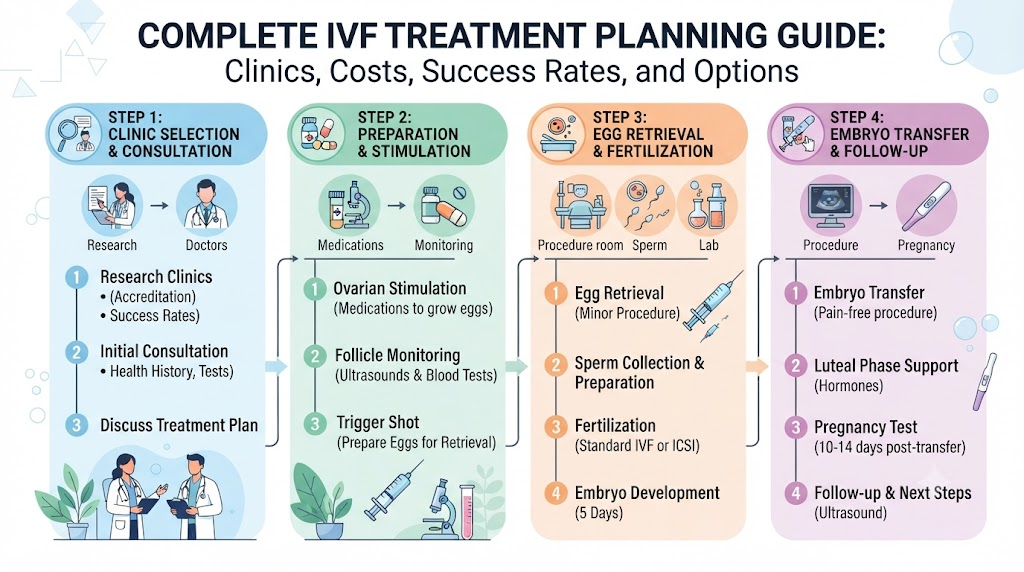
The IVF journey typically follows a structured sequence of medical stages, though the exact timeline and protocol can vary based on individual patient needs.
Initial Fertility Assessment
Before any treatment begins, doctors typically conduct a comprehensive medical review. This assessment may include reviewing medical and fertility history, hormone blood tests, pelvic imaging, and a semen analysis. These diagnostic steps help the specialist understand the underlying causes of fertility challenges and design a personalized treatment plan.
Ovarian Stimulation
To increase the likelihood of retrieving healthy eggs, patients often undergo controlled ovarian stimulation using fertility medications. These hormone injections encourage the ovaries to develop multiple mature follicles simultaneously, rather than the single egg typically released during a natural menstrual cycle.
Egg Retrieval
Once the follicles reach maturity, a minor surgical procedure known as egg retrieval is performed under light sedation. Using ultrasound guidance, a specialist carefully collects the fluid and eggs from the ovarian follicles using a thin needle.
Fertilization and Embryo Development
Following retrieval, the collected eggs are combined with prepared sperm in a specialized laboratory. Embryologists monitor the resulting embryos over the next several days to observe division and growth, identifying which embryos develop normally and are suitable for transfer or preservation.
Embryo Transfer
During an embryo transfer procedure, a thin catheter is used to place one or more selected embryos directly into the uterine cavity. This step is typically brief and performed without anesthesia, resembling a standard pelvic exam.
Follow-Up and Pregnancy Testing
Approximately 10 to 14 days after the embryo transfer, a blood test is performed to measure hormone levels and confirm whether pregnancy has been successfully achieved. Follow-up consultations with the specialist help determine the next steps based on the results.
IVF Treatment Cost and What It Includes
Financial planning is a major consideration for anyone exploring reproductive medicine. Understanding the total IVF treatment cost requires looking beyond base clinic fees to see what services are bundled into a package. A standard financial breakdown typically involves several distinct components:
- Initial Consultations: Meetings and discussions with fertility specialists to review diagnostic test results and establish a treatment plan.
- Diagnostic Testing: Blood panels, ultrasounds, and specialized evaluations required prior to cycle initiation.
- Medication Expenses: Hormonal medications used during the stimulation and preparation phases.
- Monitoring Appointments: Frequent ultrasounds and blood draws during stimulation to track follicle development.
- Egg Retrieval Procedure: Operating room fees, anesthesia, and clinical staff costs associated with the retrieval surgery.
- Laboratory Services: Fertilization, culture media, embryology expertise, and embryo monitoring.
- Embryo Transfer: Clinical fees for the physical placement of the embryo.
- Follow-Up Care: Post-transfer monitoring and pregnancy confirmation testing.
Because every patient responds differently to medications and protocols, the final expenses can fluctuate. Patients should request itemized financial estimates from clinics to avoid unexpected out-of-pocket expenses.
Factors That Can Affect IVF Treatment Cost
The total financial investment required for assisted reproduction varies widely. Several variables influence the final bottom line:
- Patient Age and Medical Profile: Older patients or those with complex diagnoses may require higher dosages or alternative medication protocols.
- Number of Cycles: Because a single cycle does not always result in a successful pregnancy, some patients budget for multiple attempts or frozen embryo transfer cycles.
- Additional Procedures: Specialized laboratory techniques, such as pre-implantation genetic testing or ICSI, add to the overall expenses.
- Geographic Location: Clinic overhead, regional healthcare costs, and local economic factors influence base pricing.
- Medication Requirements: Brand-name versus generic medications and varying bodily responses to hormones can alter pharmaceutical budgets.
- Storage Fees: Cryopreservation of remaining embryos incurs ongoing annual storage fees.
Understanding IVF Success Rates
Interpreting clinical outcomes requires looking closely at how success is defined. IVF success rates generally refer to the percentage of treatment cycles that result in a clinical pregnancy or a live birth. However, these statistics are not uniform across all demographics. Key factors that influence success include maternal age, ovarian reserve, sperm quality, underlying fertility conditions, and the quality of the laboratory facilities. Furthermore, success rates should always be viewed in context—such as whether the data represents a single transfer or a cumulative series of attempts, and whether fresh or frozen embryos were used. Patients are encouraged to ask clinics how their specific success rates are calculated for patients sharing similar medical backgrounds.
How to Compare Fertility Clinics
Choosing where to seek care is a major decision. When patients compare fertility clinics, they should look beyond marketing materials and examine key operational areas:
- Specialist Expertise: The credentials, board certifications, and clinical experience of the reproductive endocrinologists.
- Laboratory Standards: The technology, air filtration systems, and credentials of the embryology lab, as laboratory quality plays a massive role in embryo development.
- Transparency: Clear communication regarding pricing, success-rate reporting, and potential risks.
- Patient Support: Access to nursing staff, counselors, and responsive administrative coordinators.
- Treatment Availability: Whether the clinic offers the specific services or advanced technologies required for a patient’s diagnosis.
What to Look for When Choosing IVF Clinics
Evaluating individual IVF clinics involves a careful review of practical and clinical indicators. Patients should verify whether the facility maintains recognized accreditations and whether the medical team takes time to explain treatment alternatives thoroughly. A supportive environment where patients feel heard and informed can greatly ease the emotional strain of the fertility journey.
IVF Abroad: Important Things to Consider
As patients seek accessible or specialized care, many explore IVF abroad. Traveling internationally for medical treatment involves weighing potential cost savings against logistical challenges. Factors to evaluate include:
- Regulatory Standards: Understanding local healthcare laws, patient rights, and clinic oversight in the destination country.
- Travel and Logistics: Managing flights, extended stays, visa requirements, and local transportation.
- Language and Communication: Ensuring clear, direct dialogue with medical professionals without translation barriers.
- Continuity of Care: Coordinating pre-treatment diagnostics and post-treatment monitoring with local physicians at home.
- Total Expenses: Factoring in accommodation, food, travel insurance, and currency exchange rates alongside medical fees.
Understanding IVF Cost by Country
The prevailing IVF cost by country differs significantly due to variations in national healthcare subsidies, operational overhead, pharmaceutical pricing, and local labor costs. While some regions offer lower base prices, patients must evaluate whether those estimates include necessary medications, monitoring, and specialized laboratory techniques, or if those are billed separately.
Egg Preservation and Fertility Preservation
For individuals wishing to delay family-building for personal, career, or medical reasons, egg freezing offers a pathway to preserve reproductive potential. The process involves ovarian stimulation, egg retrieval, and cryopreservation of mature oocytes via vitrification. While freezing eggs offers flexibility, success rates depend heavily on the age at which the eggs were frozen and the total number of healthy oocytes retrieved and successfully thawed later.
Understanding ICSI Treatment
Intracytoplasmic sperm injection, commonly known as ICSI treatment, is an advanced laboratory procedure often performed alongside IVF. In conventional IVF, sperm are placed in a dish with an egg to fertilize naturally. In contrast, ICSI involves a skilled embryologist selecting a single healthy sperm and microinjecting it directly into the center of the egg. ICSI is frequently recommended in cases of male factor infertility, previous fertilization failure, or when using surgically retrieved sperm.
Exploring Different Fertility Treatment Options
Assisted reproduction encompasses a wide spectrum of medical interventions. Understanding various fertility treatment options helps patients appreciate that IVF is just one tool among many. Other approaches may include ovulation induction medications, intrauterine insemination (IUI), surgical interventions, or donor-assisted reproduction. Specialist guidance ensures that the chosen approach aligns with the patient’s specific diagnostic findings.
How to Prepare for a Fertility Clinic Consultation
Maximizing the value of an initial appointment requires preparation. Patients should gather comprehensive medical records, including previous fertility testing, surgical histories, and a list of current medications. Bringing a written list of questions regarding timelines, financial estimates, success metrics, and recommended protocols ensures that all important topics are covered during the meeting.
Questions to Ask Before Choosing a Fertility Clinic
Before committing to a treatment center, patients should feel empowered to ask direct questions, such as:
- What is the recommended treatment plan based on my specific diagnostic results?
- What is the estimated total financial breakdown, including medications and lab work?
- How are your clinic’s success rates calculated for patients in my age group?
- Who will perform my procedures—my primary specialist or the physician on duty?
- What diagnostic and laboratory facilities are maintained on-site?
- What provisions are in place for emergency communications or after-hours care?
- How are embryos stored, and what are the associated long-term fees?
- What support services, such as counseling, are available during treatment?
Common Mistakes Patients Should Avoid When Comparing Fertility Care
Navigating fertility options can be daunting, and certain pitfalls are common among new researchers. Avoiding these missteps can lead to a smoother experience:
- Relying Solely on Price: Choosing a clinic exclusively because of a low advertised rate without checking what is excluded can lead to unexpected expenses.
- Ignoring Context in Success Rates: Comparing statistics without factoring in patient age or clinical complexity can be misleading.
- Overlooking Logistical Strains: Failing to account for travel distance, clinic hours, and monitoring frequency can create unnecessary daily stress.
- Skipping Second Opinions: Accepting a single treatment recommendation without exploring alternatives when complex diagnoses are involved.
- Neglecting Emotional Well-being: Underestimating the psychological toll of treatment and failing to utilize available support networks.
Who Can Benefit From Fertility Information Platforms?
Couples Exploring IVF
Couples beginning their reproductive journey can utilize structured educational resources to understand complex medical terminology and prepare effectively for clinical consultations.
People Comparing Fertility Clinics
Individuals evaluating multiple facilities can review essential criteria such as laboratory standards, specialist expertise, and reporting transparency to narrow down their choices.
Patients Researching Treatment Costs
Patients seeking clarity on financial planning can review itemized cost breakdowns to understand what factors drive expenses up or down.
People Considering IVF Abroad
Those researching international medical tourism can examine the logistical, regulatory, and financial factors required to make safe, informed travel decisions.
People Exploring Fertility Preservation
Individuals researching elective or medically indicated preservation options can learn about the freezing process, storage considerations, and success variables.
People Learning About Different Fertility Treatments
Readers seeking foundational knowledge can explore a range of reproductive technologies before speaking with a qualified medical professional.
Step-by-Step Guide to Researching Fertility Treatment
- Understand Your Fertility Concerns: Begin by identifying your specific health background and any initial diagnostic findings.
- Learn About Available Treatment Options: Review foundational medical procedures, from basic medications to advanced reproductive technologies.
- Research Suitable Fertility Clinics: Investigate regional and international facilities, focusing on specialist expertise and laboratory quality.
- Compare Treatment Costs: Request detailed financial estimates and itemized fee schedules from prospective clinics.
- Review IVF Success-Rate Information: Examine success metrics with appropriate context regarding age and medical history.
- Check Clinic and Laboratory Details: Verify accreditations, equipment standards, and the qualifications of the embryology team.
- Ask Questions During Your Consultation: Use your prepared list of inquiries to clarify uncertainties directly with your specialist.
- Make a Decision With Qualified Medical Guidance: Finalize your treatment pathway in collaboration with a trusted reproductive endocrinologist.
Fertility Treatment Options Overview
| Fertility Treatment Option | General Purpose | Important Consideration |
| Fertility Medicines | Stimulates ovulation and regulates hormone levels | Requires careful monitoring to manage multiple-birth risks |
| Intrauterine Insemination (IUI) | Places washed sperm directly into the uterus | Less invasive than IVF; success depends on tubal patency and sperm quality |
| In Vitro Fertilization (IVF) | Combines eggs and sperm in a lab for uterine transfer | Involves multiple clinical stages and variable medication protocols |
| ICSI Treatment | Injects a single sperm directly into an egg | Often used for severe male factor infertility or prior fertilization issues |
| Egg Freezing | Preserves unfertilized oocytes for future use | Success depends heavily on age at the time of freezing |
| Embryo Freezing | Cryopreserves created embryos for subsequent transfer | Allows future sibling attempts or delayed transfer cycles |
| Donor-Assisted Treatment | Utilizes donor eggs, sperm, or embryos | Involves legal, psychological, and ethical considerations |
IVF Clinic Comparison Matrix
| Clinic Comparison Factor | What to Check | Why It Matters |
| Treatment Cost | Itemized fee schedules and package inclusions | Prevents unexpected financial surprises during active cycles |
| Success-Rate Reporting | Data stratified by age and diagnosis | Provides a realistic expectation of clinical outcomes |
| Specialist Expertise | Board certifications and reproductive endocrinology experience | Ensures care is directed by qualified medical professionals |
| Laboratory Facilities | Air filtration, incubator technology, and embryologist credentials | Directly impacts embryo development and viability |
| Treatment Options | Availability of advanced ART procedures | Ensures your specific medical needs can be met under one roof |
| Follow-Up Care | Post-transfer monitoring and pregnancy confirmation protocols | Guarantees continuous medical oversight through early pregnancy |
| Location | Proximity to home or accommodation arrangements | Reduces travel fatigue during frequent monitoring visits |
| Additional Costs | Cryopreservation, storage, and medication fees | Clarifies the true long-term financial commitment |
Common Challenges When Researching IVF Treatment
Patients often encounter hurdles while gathering information online. Information overload, conflicting success statistics, and unclear pricing structures can complicate decision-making. Medical terminology can also be intimidating. Overcoming these challenges involves relying on evidence-based educational resources, consulting multiple reputable sources, and discussing findings directly with qualified medical professionals rather than relying solely on anecdotal forum discussions.
Best Practices for Fertility Clinic Research
When researching fertility care, approach the process methodically. Look beyond initial price points to evaluate the comprehensive quality of care. Investigate laboratory accreditations, speak with clinic coordinators to test communication responsiveness, and ensure that treatment plans are tailored to your unique medical profile rather than a generic one-size-fits-all model.
How to Evaluate Online Fertility Information Responsibly
Evaluating digital health content requires discernment. Readers should check the authority of the publishing source, ensure that information reflects current medical standards, and remain skeptical of guaranteed outcome claims. Educational content should clarify options and empower discussions, but it should never replace individualized advice from a licensed medical specialist.
Frequently Asked Questions
1. What factors affect IVF treatment cost?
Overall expenses are influenced by the clinic’s location, required medication dosages, diagnostic testing, specialized laboratory procedures, and the number of treatment cycles attempted.
2. How should patients understand IVF success rates?
Success rates should be evaluated in the context of patient age, specific diagnoses, and whether data reflects fresh or frozen embryo transfers rather than generalized guarantees.
3. What should people check when choosing IVF clinics?
Key factors include specialist credentials, embryology laboratory standards, cost transparency, communication quality, and patient support services.
4. How can patients compare fertility clinics?
Patients can compare facilities by reviewing verified success-rate data, evaluating lab technologies, requesting itemized fee structures, and scheduling initial consultations.
5. What should patients consider before choosing IVF abroad?
Important considerations include international medical standards, travel logistics, language barriers, continuity of care with local physicians, and total travel expenses.
6. Why can IVF cost by country vary?
National economic differences, healthcare regulations, labor costs, and government subsidies heavily influence regional pricing structures for assisted reproductive services.
7. What is egg freezing?
Egg freezing is a fertility preservation method where mature oocytes are retrieved, frozen, and stored via vitrification for potential future use.
8. What is ICSI treatment?
ICSI is a specialized laboratory procedure where a single sperm is injected directly into an egg to facilitate fertilization during an IVF cycle.
9. What fertility treatment options may be available?
Depending on diagnostic findings, options range from ovulation-inducing medications and IUI to conventional IVF, ICSI, and donor-assisted reproduction.
10. What questions should patients ask before starting IVF treatment?
Patients should inquire about personalized success estimates, total financial breakdowns, medication requirements, laboratory standards, and the expected treatment timeline.
Conclusion
Researching fertility care is a deeply personal and significant undertaking. Whether you are exploring basic diagnostic information, examining IVF treatment cost, reviewing IVF success rates, or learning how to compare fertility clinics, having access to clear and structured guidance is essential. While procedures such as egg freezing and ICSI treatment offer specialized pathways, and international options like IVF abroad or understanding the IVF cost by country provide broader perspectives, every reproductive journey remains entirely unique. Patients are strongly encouraged to use informational resources to educate themselves, carefully evaluate their fertility treatment options, and discuss their individual medical circumstances, risks, and expected outcomes with a qualified fertility specialist.