

Introduction
Finding reliable guidance when faced with a legal issue is essential, yet the internet often presents a maze of conflicting answers. When a dispute arises or a contract needs review, turning to a search engine is usually the first step. While digital platforms offer unprecedented convenience, they also expose readers to incomplete, outdated, or misleading information. Relying on unverified sources can lead to severe misunderstandings, missed deadlines, and financial loss. Learning how to identify unreliable guidance, verify legal information, and recognize the limits of online research is crucial for protecting your rights and making informed decisions.
Why Wrong Legal Advice Online Can Be a Serious Problem
Incorrect legal information can turn a minor dispute into a major crisis. Many internet articles present broad generalizations that fail to account for specific statutory exceptions, local amendments, or recent court judgments. When people act on such flawed guidance, they often worsen their legal position rather than resolve it. Consider common everyday scenarios. A tenant in Mumbai might read an online article about eviction rules that only applies to residential properties in Delhi, leading them to withhold rent improperly and face legal action. Similarly, a small business owner might copy a standard employment contract from an anonymous forum without realizing it violates local labor codes, resulting in costly compliance penalties. Legal rights and obligations depend entirely on specific facts, documentation, and the governing law. Misunderstanding these elements can cause individuals to miss critical court deadlines, forfeit financial claims, or enter into legally binding agreements that disadvantage them.
Understanding the Difference Between Legal Information and Legal Advice
A foundational step in safe online research is recognizing the distinction between general legal information and personalized legal advice. General legal information encompasses articles, blog posts, government summaries, and educational guides that explain how laws work in a broad sense. These resources describe statutory frameworks, general procedures, and historical court interpretations. Personalized legal advice, by contrast, is tailored explicitly to an individual’s unique factual situation, documents, and objectives. Only a qualified advocate who has reviewed all relevant evidence, examined contracts, and understood the timeline of events can provide true legal counsel. Treating a general online article as a definitive legal opinion for a specific dispute is a dangerous mistake. Online content can point you in the general direction of your rights, but it cannot substitute for professional analysis.
Common Sources of Wrong Legal Advice Online
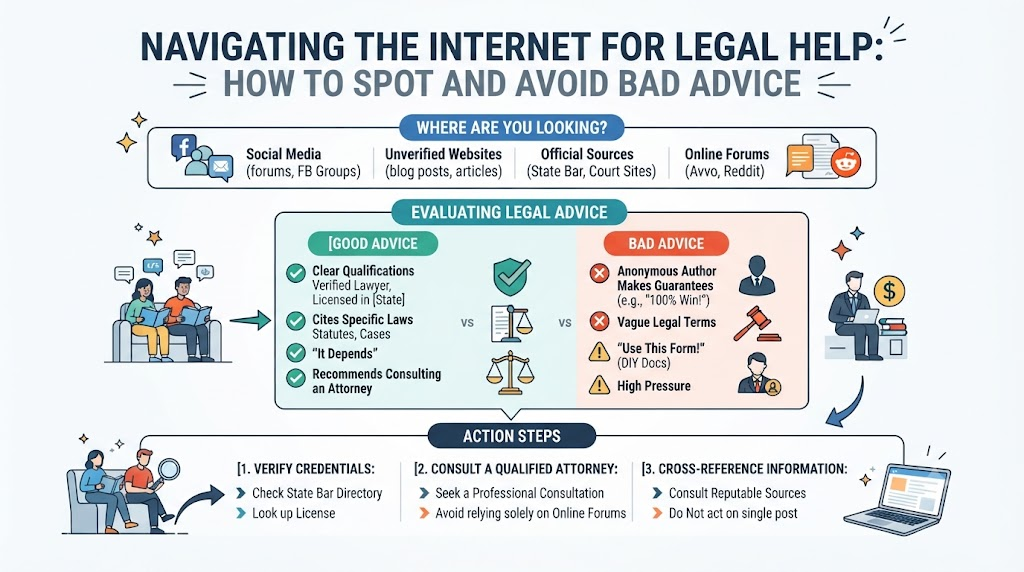
Misleading legal information appears across numerous digital channels, often disguised as expert commentary. Recognizing these sources helps readers approach online content with appropriate caution.
- Social Media Posts and Reels: Short-form videos and platform posts frequently distill complex legal statutes into viral soundbites, omitting vital exceptions and nuances for the sake of engagement.
- Online Discussion Forums: Public forums allow anyone to answer legal questions anonymously. While contributors often mean well, their advice is frequently based on personal anecdotes rather than sound legal doctrine.
- Unverified Blogs and Content Farms: Many websites publish scraped or poorly researched legal articles solely to drive traffic, often copying outdated statutes without verification.
- AI-Generated Answers: Automated tools can summarize legal concepts quickly, but they are prone to fabricating case citations, misinterpreting statutes, and missing jurisdiction-specific rules.
Popularity or ease of reading does not equal legal accuracy. Readers must look beyond polished presentations to verify the actual substance of the content.
Warning Signs of Misleading Legal Advice
Spotting unreliable guidance requires vigilance. Certain red flags indicate that a legal source or article should not be trusted without rigorous cross-checking.
- Guaranteed Outcomes: Claims that a court victory is certain or that a specific legal strategy has a 100% success rate ignore the inherent unpredictability of litigation and judicial discretion.
- Urgent Pressure Tactics: Warnings that demand immediate financial transfers or hasty document signing without proper explanation often point to predatory practices.
- Outdated References: Content that cites repealed legislation or ignores landmark amendments indicates lazy research or stale information.
- Omission of Facts: Advice that claims a single rule applies universally across every dispute, regardless of contract terms or state laws, is fundamentally flawed.
Recognizing these signs protects readers from falling victim to misinformation or unscrupulous actors.
Comparison: Reliable vs. Questionable Legal Information
| Reliable Legal Information | Potentially Misleading Legal Information |
| Identifies its source and author where possible. | Provides no clear source or author details. |
| Includes relevant legal references. | Makes legal claims without supporting references. |
| Explains important limitations and exceptions. | Presents complicated legal issues as simple universal rules. |
| Identifies the relevant jurisdiction. | Ignores differences between states or legal systems. |
| Provides publication or update dates. | Has no clear date or relies on outdated material. |
| Avoids guaranteed legal outcomes. | Promises certain results without considering case facts. |
| Encourages verification and professional consultation when needed. | Pressures readers to act without checking the information. |
These indicators serve as general guidelines rather than absolute guarantees. Even well-structured legal content must be evaluated against your specific circumstances and verified through official channels.
How to Check Whether Online Legal Information Is Reliable
Reviewing online legal content systematically helps filter out noise and inaccuracy. Follow a structured verification process before acting on any digital guidance. First, check the author and publication credentials. Credible articles are written or reviewed by legal professionals and reference established statutes. Second, examine the publication and update dates. Laws change frequently through legislative amendments and judicial precedents, making stale content hazardous. Third, look for specific legal citations. An article that mentions section numbers, relevant acts, or governing authorities is easier to verify than one that relies on vague generalizations. Finally, cross-reference the claims with official government portals or consult a qualified advocate to confirm their applicability to your issue.
Use Official Legal Sources for Verification
Verifying claims against official legal repositories is the most effective way to ensure accuracy. India offers several authoritative public resources for researching statutes and court rulings.
- India Code: The official repository of central legislations, providing access to acts, rules, and amendments passed by the Parliament.
- Supreme Court and High Court Portals: Official judicial websites offer authentic judgments, cause lists, and procedural rules.
- Government Ministry Portals: Departments such as the Ministry of Corporate Affairs, Ministry of Consumer Affairs, or state revenue departments publish official circulars and guidelines.
Always check the enactment date and current status of any statute or notification you review, as laws undergo frequent revisions.
Check Whether Legal Advice Applies to Your State and Situation
Jurisdiction is a cornerstone of Indian law. Matters governed by central legislation still interact with state-specific rules, local municipal bylaws, and regional high court rulings. For instance, property laws, tenancy regulations, and stamp duty requirements vary significantly across different states. An online guide written for property registration in one state may contain entirely incorrect fee structures or procedural requirements for another. Readers must verify whether an article addresses federal law, state-specific amendments, or local court rules before applying its principles to their own disputes.
Be Careful With Legal Advice on Social Media and Discussion Forums
Public discussion boards and social media comment sections are valuable for sharing general experiences, but they are dangerous places to source legal strategy. Anonymous contributors rarely possess full knowledge of the relevant facts, and their personal success in a past dispute does not mean the same approach will work for you. Treat online discussions purely as a means to build general awareness or identify common issues. Never base financial, contractual, or legal decisions on peer comments found on open forums.
Understand the Risks of AI-Generated Legal Answers
Artificial intelligence tools offer remarkable utility for breaking down complex legal terminology, drafting rough outlines, and organizing questions before a consultation. However, relying on AI for definitive legal answers carries distinct risks. AI models can hallucinate case citations, reference outdated statutory provisions, and overlook critical procedural exceptions. Because they lack human analytical rigor and cannot review original physical documents or assess opposing arguments, AI-generated outputs must always be independently verified by a human legal expert. Furthermore, users should avoid inputting confidential personal data or sensitive case documents into public AI interfaces to protect their privacy.
How to Verify a Lawyer’s Credentials Before Seeking Advice
When you decide to move from online research to professional consultation, verifying your advocate’s credentials is essential. Legitimate legal professionals maintain active enrolments with their respective State Bar Councils. Review the advocate’s official name, enrolment number, years of experience, and primary practice areas. While online directories, professional websites, and client testimonials offer helpful background, they should be supplemented by direct communication and consultation to ensure the advocate’s expertise aligns with your specific legal needs.
Questions to Ask Before Accepting Legal Advice
A productive legal consultation involves a two-way dialogue. Asking the right questions helps ensure you understand your options and the reasoning behind your advocate’s strategy.
- What specific laws or statutory provisions govern my situation?
- What are the viable legal options available, and what are the risks of each approach?
- What are the expected timelines and critical deadlines for this matter?
- What documents and evidence do we need to gather immediately?
- What is the anticipated fee structure and cost breakdown for these proceedings?
Do not hesitate to ask for clarification on legal terms or procedural steps until you feel fully confident in the proposed course of action.
When to Seek a Second Legal Opinion
Obtaining a second legal opinion is a prudent step in many circumstances. Consider consulting another advocate if you face complex litigation, high-stakes property transactions, severe financial consequences, criminal charges, or conflicting legal explanations from your initial consultation. A second opinion provides fresh perspective, identifies overlooked angles, and ensures your legal strategy is robust. Seeking another perspective does not reflect poorly on your first advocate; rather, it represents a diligent approach to safeguarding your interests.
Mistakes to Avoid When Searching for Legal Advice Online
- Trusting the first search result without evaluating its author or credibility.
- Relying entirely on social media threads or anonymous forum comments for legal strategy.
- Ignoring publication dates and applying outdated statutes to current disputes.
- Assuming that legal rules from another state or country apply locally.
- Copying legal agreements or notices from the internet without professional customization.
- Delaying professional consultation when urgent deadlines or serious legal matters are involved.
Avoiding these common pitfalls keeps your research grounded and protects you from avoidable legal complications.
Protect Your Personal Information During Online Legal Research
Privacy is paramount when dealing with legal matters. Sharing sensitive documents, identity proofs, financial statements, or details of private disputes on public forums or unverified websites exposes you to identity theft, fraud, and breach of confidentiality. Always use secure communication channels, verify website privacy policies, and restrict the sharing of confidential case papers strictly to qualified professionals who have a legitimate, authorized role in your representation.
How WakilSahab Helps Readers Explore Legal Information and Lawyers
Navigating the Indian legal landscape requires trusted resources and accessible connections. WakilSahab serves as a comprehensive platform designed to help citizens explore legal practice areas, read educational content, participate in community discussions, and discover qualified advocates across India. Whether you are looking to understand your rights through verified articles or seeking professional legal assistance, WakilSahab bridges the gap between everyday legal questions and verified legal professionals. It functions as an empowering starting point for legal awareness and lawyer discovery, complementing—never replacing—tailored professional counsel.
A Practical Checklist for Avoiding Wrong Legal Advice Online
- Check the author, publisher, and credibility of the platform.
- Verify the publication and update dates to ensure laws are current.
- Confirm that the guidance matches your specific state jurisdiction.
- Cross-reference claims against official government and court sources.
- Avoid making important decisions based solely on social media or forum posts.
- Protect your personal and financial data during online research.
- Consult a qualified advocate for personalized legal advice.
Building Better Habits for Responsible Online Legal Research
Developing disciplined research habits transforms how you use the internet for legal queries. Keep organized notes of sources, record important dates, and compile clear questions before speaking with an expert. Treat online articles as educational stepping stones rather than final answers, and always prioritize verified professional counsel when dealing with high-stakes decisions.
Frequently Asked Questions
1. How can I identify wrong legal advice online?
Look for warning signs such as guaranteed outcomes, missing author details, outdated statutory references, and the absence of jurisdiction-specific limitations.
2. Is online legal advice reliable in India?
General legal information online can be educational, but it is not tailored to your specific situation and should always be verified before taking action.
3. How can I verify legal information found on the internet?
Cross-reference claims with official government portals like India Code, check court judgment repositories, and consult a qualified advocate.
4. Can social media provide reliable legal advice?
No. Social media posts and short videos often simplify complex laws, omit critical exceptions, and reflect personal opinions rather than verified legal rules.
5. How do I check whether a legal article is up to date?
Look for a clear publication or revision date and check whether the cited acts, sections, or amendments have been recently modified.
6. Can AI-generated legal answers be trusted?
AI tools help explain general concepts, but they can fabricate case citations and miss local legal nuances, requiring independent verification.
7. Why is jurisdiction important when checking legal advice?
Laws, court procedures, stamp duties, and tenancy rules vary across Indian states and local municipalities, meaning a rule from one area may not apply in another.
8. When should I consult a qualified advocate?
You should consult an advocate whenever you face formal legal notices, court proceedings, complex property transactions, or significant financial decisions.
9. Is it acceptable to seek a second legal opinion?
Yes. Seeking a second opinion is a prudent step for complex disputes, high-stakes matters, or when you need clarity on conflicting legal advice.
10. How can WakilSahab help me explore lawyers and legal information?
WakilSahab provides access to educational legal content, practice area guides, community discussions, and a directory of qualified advocates across India.
Conclusion
Navigating digital legal resources requires caution, critical thinking, and a commitment to verification. While online articles and guides improve general legal awareness, they cannot replace the nuanced analysis required for individual disputes. By checking sources, confirming jurisdiction, protecting personal data, and consulting qualified professionals when necessary, you can avoid the pitfalls of misleading advice. WakilSahab remains dedicated to helping Indian citizens explore legal resources and connect with trusted advocates, empowering you to make informed, responsible legal decisions.