

Introduction
Continuous integration, faster delivery cycles, and highly resilient cloud systems are no longer luxury items for modern tech enterprises—they are survival requirements. As organizations shift away from traditional, siloed IT infrastructures toward automated, platform-centric models, the demand for cross-functional engineers has skyrocketed. Navigating this vast landscape can feel overwhelming. With separate domains emerging for security DevSecOps, reliability SRE, cloud platforms, container orchestration, and artificial intelligence MLOps, finding a structured path forward is a common challenge for tech professionals. Whether you are a computer science student, a systems administrator looking to modernize your skillset, or an engineering manager aiming to upskill your team, finding the right path is crucial.
What is a DevOps Certification?
A DevOps certification is a formal, third-party validation of an engineer’s ability to design, implement, and manage automated software delivery pipelines and cloud infrastructure. Far from being a mere piece of paper, a modern certification serves as a structured learning path that guides you through a curated curriculum of tools, methodologies, and architectural philosophies. It validates that you don’t just know how to use a specific tool, but that you understand the underlying patterns of collaboration, scale, and resilience.
These programs bridge the gap between theoretical knowledge and production-grade execution by incorporating rigorous hands-on practice. A valid certification proves you can manage containerized deployments, handle live infrastructure-as-code scripts, secure CI/CD pipelines, and maintain system availability under high traffic conditions. In short, it shows the industry that your technical skills meet rigorous, real-world standards.
Why DevOps Certifications Matter
1. Structured Learning Path (Sahi Rasta)
DevOps ka ecosystem bohot bada hai—Linux, Docker, Kubernetes, Jenkins, Terraform, AWS, Prometheus, aur na jaane kya-kya. Agar aap khud se seekhne nikalte ho, toh samajh nahi aata ki kahan se shuru karein aur kahan khatam. Ek certification aapko ek systematic roadmap deti hai, jisse aap fuzool tools par waqt barbad karne ke bajaye wahi seekhte ho jo industry me sach me use ho raha hai.
2. Hands-on Validation (Asli Kaam ki Janch)
Purane zamane ke exams ki tarah ab sirf ratta maar kar DevOps exams clear nahi kiye ja sakte. For example, CKA (Certified Kubernetes Administrator) jaise exams me aapko koi multiple-choice questions nahi milte. Aapko ek live terminal (command line) diya jata hai aur bola jata hai: “Ye cluster toot gaya hai, isko 10 minute me theek karo.” Agar aapne certification clear ki hai, toh employer ko pata hota hai ki aapko real-world me kaam karna aata hai.
3. High Market Demand & Career Growth
Enterprise companies (jaise banks, tech giants, e-commerce platforms) ab apna saara infrastructure cloud aur automation par shift kar rahi hain. Unhe aise engineers chahiye jo bina galti kiye production systems ko scale kar sakein. Certified professionals ko hamesha pehli priority milti hai, jiska seedha asar hiring speed, promotion, aur high salary packages par padta hai.
To maximize your return on investment, approach your certification journey through this systematic, four-step process:
- Identify the Skill Gap: Evaluate your current capabilities against your target role (e.g., transitioning from SysAdmin to Site Reliability Engineer) to find the certification that addresses your specific weak points.
- Engage in Deep Lab Work: Avoid short-term memorization or exam dumps. Spend time in sandbox cloud environments writing configuration files, building pipelines, and intentionally breaking systems to learn how to fix them.
- Validate via Peer/Community Review: Participate in open-source projects or study groups to apply your target methodologies in collaborative, multi-user scenarios that mimic real engineering teams.
- Earn and Apply the Credential: Once certified, immediately implement those advanced patterns in your current production environments, or showcase your portfolio of practical labs to stand out in interviews.
Who Should Take DevOps Certifications?
DevOps methodologies have expanded far beyond general software deployment. They now form the foundational backbone for almost every modern technical discipline. This guide and these certification paths are intentionally designed for:
- Students & Freshers: Aspiring engineers looking to break into tech with verified, industry-relevant skills that make up for a lack of corporate tenure.
- Software Engineers & QA Professionals: Developers looking to write deployment-aware code and automated testing frameworks that fit seamlessly into continuous delivery pipelines.
- System Administrators & Cloud Engineers: Infrastructure professionals moving away from manual configuration toward automated, programmatic cloud management.
- SRE & DevSecOps Professionals: Specialists focused on building ultra-reliable, self-healing platforms and embedding automated security gates directly into build pipelines.
- Data & ML Engineers: Data professionals looking to scale AI/ML models out of experimental notebooks and into automated, high-availability production environments.
- IT Managers & Platform Leaders: Technical leaders who need a comprehensive view of engineering workflows to lead successful organizational transitions.
Core Skills Covered in Modern Certifications
To stay competitive in today’s tech landscape, you need to develop a well-rounded mix of soft skills and deeply technical competencies. Modern certification pathways focus heavily on six core pillars:
- Continuous Integration & Continuous Delivery (CI/CD): Designing automated pipelines that test, package, and deploy code updates with zero downtime.
- Infrastructure as Code (IaC): Treating infrastructure exactly like software application code by writing declarative, version-controlled scripts to provision entire cloud environments automatically.
- Containerization & Orchestration: Packaging applications with all their dependencies into lightweight, isolated containers, and managing them at scale across vast server clusters.
- Continuous Monitoring & Observability: Implementing distributed tracking, centralized log aggregation, and real-time alerting systems to diagnose complex system health issues before they affect end users.
- DevSecOps & Automated Security: Injecting automated compliance checks, vulnerability scanning, and secret management directly into early development stages.
- MLOps & AI Infrastructure: Designing automated retraining pipelines, data versioning architectures, and scalable compute clusters to host complex machine learning models safely.
Overview of the Top 20 Certifications
The table below outlines the top 20 certifications designed to validate your technical expertise across various cloud platforms, automation tools, and specialized roles.
Table 1: Master List of Top DevOps Certifications
| Certification Name | Best For | Skill Level | Career Direction |
| 1. DevOps Certified Professional (DCP) | Core DevOps Foundational Concepts | Beginner | Associate DevOps Engineer |
| 2. DevSecOps Certified Professional (DSOCP) | Shifting Security Left in CI/CD | Intermediate | DevSecOps / Security Engineer |
| 3. Site Reliability Engineering (SRE) Certified Professional | Scale, High Availability, & Automation | Advanced | SRE / Platform Engineer |
| 4. Master in DevOps Engineering (MDE) | Comprehensive End-to-End Tools Mastery | Intermediate | Senior DevOps Engineer |
| 5. Master in Azure DevOps | Enterprise Microsoft Ecosystems | Intermediate | Azure DevOps / Cloud Architect |
| 6. AWS Certified DevOps Professional | Advanced AWS Cloud Automation | Advanced | AWS Cloud DevOps Engineer |
| 7. Master in Python Programming | Automation Scripting & Tool Customization | Beginner | DevOps Automation Engineer |
| 8. HashiCorp Certified Terraform Associate | Declarative Multicloud IaC Management | Intermediate | Cloud Infrastructure Engineer |
| 9. Certified Kubernetes Administrator (CKA) | Production-Grade Container Orchestration | Advanced | Kubernetes / Platform Engineer |
| 10. Docker Certified Associate (DCA) | Containerization & Microservices Isolation | Intermediate | Container Platform Engineer |
| 11. Envoy Istio Certification Training | Microservices Traffic & Service Mesh Management | Advanced | Cloud Native Architect |
| 12. MLOps Certification Training Course | Scaling AI & Machine Learning Pipelines | Advanced | MLOps / AI Platform Engineer |
| 13. Google Cloud Professional Cloud DevOps Engineer | SRE Practices & Google Cloud Services | Advanced | GCP DevOps Engineer / SRE |
| 14. Master in Machine Learning | Statistical Modeling & Algorithm Design | Intermediate | Machine Learning Engineer |
| 15. Master in Artificial Intelligence | Neural Networks & Intelligent Systems | Advanced | AI Research / Solutions Engineer |
| 16. Master in AppDynamics | Enterprise Application Performance Monitoring | Intermediate | Observability Specialist |
| 17. Master in Data Science | Data Engineering & Analytics Pipelines | Intermediate | Data Infrastructure Engineer |
| 18. Master in Deep Learning | Advanced Vision, NLP, & Compute Infrastructure | Advanced | Deep Learning Engineer |
| 19. Prometheus with Grafana | Open-Source Metrics, Dashboards, & Alerting | Intermediate | Monitoring & SRE Specialist |
| 20. GitOps Certified Professional (GOCP) | Declarative Git-Driven CD Automation | Advanced | GitOps / Platform Engineer |
Certification Deep Dive
To give you a clear, practical look at what these certifications look like in the real world, let’s explore their operational realities, required skill sets, and training expectations.
Foundational Profiles & Expectations
- Real-World Use Case: Imagine a retail platform handling massive traffic surges during a holiday sale. Suddenly, a microservice experiences a memory leak. In an un-automated setup, this would mean frantic midnight calls, manual server restarts, and lost revenue. In a mature cloud environment, automated monitoring immediately flags the anomaly. The container orchestrator quarantines the failing container, provisions a healthy replacement, and scales the underlying cloud infrastructure out to handle the load—all without a single manual intervention.
- Skills You Will Learn: You will master declarative infrastructure provisioning, distributed application observability, multi-stage automated build architectures, zero-downtime deployment patterns (like blue-green and canary releases), cloud security isolation, and automated anomaly response loops.
- Career Scope: The industry is moving heavily toward platform engineering and self-healing infrastructure. Certified professionals routinely move into senior architecture roles, direct strategic cloud transformations, and command premium compensation packages across global enterprises.
- Difficulty Level: Varies from Intermediate (for single-tool validations like Terraform or Docker) to Advanced (for performance-based, live-terminal examinations like the Certified Kubernetes Administrator or platform professional exams).
- Best Career Fit / Who Should Take It: Systems engineers looking to write software-driven infrastructure, application developers wanting control over their runtime environments, and traditional IT practitioners transitioning away from legacy, manual data centers.
- Hands-On Projects: Over the course of these certifications, you will build and launch multiple production-ready environments, including:
- A fully automated, multi-region CI/CD deployment pipeline featuring inline automated security scans.
- A secure, highly available Kubernetes cluster running on multi-cloud infrastructure provisioned entirely via version-controlled code scripts.
- An end-to-end observability dashboard tracking real-time telemetry metrics, trace routing, and centralized logs with automated paging integrations.
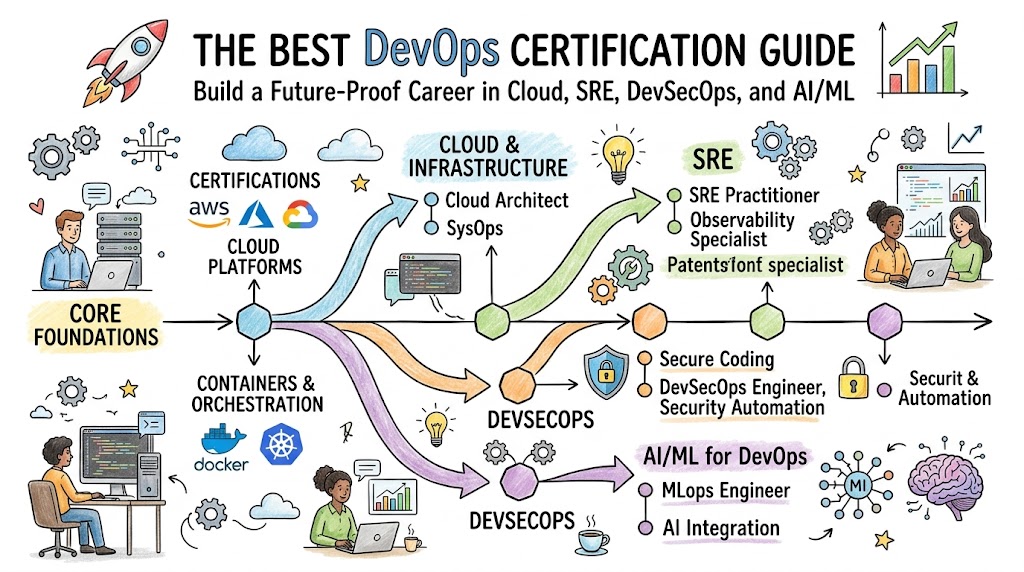
DevOps Certification Roadmap
Building a long-term career requires a strategic approach. This structured roadmap shows you exactly how to align your certification choices with your specific professional milestones.
Table 2: Role-Based Career Navigation
| Target Career Goal | Recommended Certification Path | Why It Fits |
| Cloud Infrastructure Architect | DCP ➔ Terraform Associate ➔ AWS/Azure Professional | Validates your foundational cloud knowledge before moving into multi-cloud infrastructure-as-code and advanced automation architectures. |
| Enterprise Platform Engineer | MDE ➔ Docker Certified Associate ➔ CKA ➔ GitOps Professional (GOCP) | Combines a broad knowledge of DevOps tools with deep container orchestration and declarative, Git-driven deployment workflows. |
| DevSecOps / Security Specialist | DCP ➔ DevSecOps Certified Professional (DSOCP) ➔ CKA | Ensures automated security scans, secret shielding, and image compliance checks are embedded directly into your core container runtimes. |
| Site Reliability Engineer (SRE) | SRE Certified Professional ➔ Prometheus with Grafana ➔ Envoy Istio | Focuses heavily on service mesh architecture, open-source metrics collection, and building highly resilient, self-healing platforms. |
| MLOps / AI Platform Engineer | Master in Python ➔ Data Science / ML Master ➔ MLOps Certification | Bridges the gap between data science models and automated, production-grade cloud scale and infrastructure tracking. |
Types of DevOps Certifications
As the ecosystem matures, certifications have naturally split into three distinct categories to help you tailor your learning to your specific career goals:
1. Generalist & Framework Certifications
These programs focus on core concepts, team collaboration, and end-to-end software delivery methodologies independent of any single vendor. Examples include the DevOps Certified Professional (DCP) and Master in DevOps Engineering (MDE). They are ideal for establishing a strong foundation in modern software development lifecycles.
2. Cloud Platform Specialists
These certifications focus deeply on the native automation systems and managed services of specific cloud providers. Options like the AWS Certified DevOps Professional and Master in Azure DevOps validate your ability to build, secure, and scale applications within those specific cloud ecosystems.
3. Deep-Dive Tool & Cloud-Native Authorities
These highly practical validations focus on specific components of modern cloud-native infrastructure. Programs like the Certified Kubernetes Administrator (CKA), HashiCorp Certified Terraform Associate, and GitOps Certified Professional (GOCP) prove you have deep, hands-on mastery of industry-standard tools for container orchestration, infrastructure as code, and continuous deployment.
Common Mistakes to Avoid
- Collecting “Paper” Badges Without Hands-On Practice: Relying on exam dumps or multiple-choice memorization without spinning up live cloud consoles or typing real terminal commands leaves you unprepared for real technical interviews.
- Over-Focusing on Single Tools While Ignoring Underlying Patterns: Learning how to write a tool configuration file without understanding core networking, security protocols, and architectural principles limits your ability to solve complex production issues.
- Neglecting Linux Internals and Core Networking Principles: Every advanced container system and cloud platform runs on Linux foundations. Skipping fundamental concepts like DNS routing, SSH keys, file permissions, and process signals makes troubleshooting very difficult.
- Ignoring Team Culture, Collaboration, and Feedback Loops: DevOps is as much about breaking down organizational silos and refining feedback systems as it is about automation. A certified engineer who ignores communication workflows misses the big picture.
Real-Life Examples of Certified Success
- Example 1: A legacy systems administrator earned her HashiCorp Certified Terraform Associate and successfully transitioned her company away from manual server provisioning, cutting environment setup times from three weeks down to just four minutes.
- Example 2: An application developer completed the DevSecOps Certified Professional (DSOCP) program and integrated automated vulnerability scanning into his team’s CI/CD pipeline, catching critical code flaws before they ever reached production.
- Example 3: A cloud engineer earned his Certified Kubernetes Administrator (CKA) credential and successfully migrated an aging monolith application into a highly resilient microservices architecture, maintaining uptime through holiday traffic surges.
- Example 4: A data analyst upskilled via the MLOps Certification Training Course, helping her enterprise scale their predictive models out of isolated Python notebooks and into automated, self-healing cloud clusters.
- Example 5: An operations specialist completed the Site Reliability Engineering (SRE) Certified Professional path, using Prometheus and Grafana to build real-time alerting systems that cut his company’s average incident response times in half.
Frequently Asked Questions
1. Which DevOps certification is best for absolute beginners?
The DevOps Certified Professional (DCP) is a great starting point because it introduces core methodologies, version control, and basic delivery pipelines without assuming prior platform experience.
2. How long does it typically take to prepare for a professional-grade DevOps exam?
Depending on your background, foundational certs take about 4 to 6 weeks, while performance-based exams like the CKA require 3 to 5 months of hands-on lab practice.
3. Do I need a strong software programming background to clear these exams?
No, you don’t need to be an expert application developer. However, having a solid grasp of scripting languages like Python or Bash is highly valuable for handling automated cloud tasks.
4. What is the main structural difference between regular DevOps and DevSecOps certifications?
Standard paths focus on deployment speed, automation, and system reliability, while DevSecOps options specifically teach you how to inject security controls, compliance checks, and secret management directly into that automation.
5. Are performance-based certifications harder than multiple-choice exams?
Yes, certifications like the CKA require you to solve real-world infrastructure problems in a live command-line terminal within a set time limit, which values practical troubleshooting over rote memorization.
6. Why should I invest time in a specialized tool certification like Terraform or Docker?
Platform-agnostic tools are used across almost every cloud provider. Mastering them makes you highly versatile, allowing you to manage multi-cloud infrastructures seamlessly.
7. How does an MLOps certification differ from a standard Data Science program?
Data Science focus tracks prioritize algorithm design and model training, whereas MLOps concentrates on building the automated infrastructure pipelines needed to deploy, monitor, and scale those models in production.
8. How often do these cloud and automation credentials expire?
Most major cloud and cloud-native certifications are valid for 2 to 3 years, ensuring that engineers stay up to date with rapidly evolving software ecosystems.
9. Can I prepare for these advanced certifications using only free online documentation?
While official documentation is incredibly valuable, structured certification courses save time by offering curated paths, mentor guidance, and pre-configured lab environments.
10. What role does GitOps play in a modern continuous delivery setup?
GitOps uses Git repositories as the single source of truth for your infrastructure. Tools like ArgoCD or Flux automatically sync your live cloud environments with your version-controlled code configurations.
Conclusion
Accelerating your career in DevOps, SRE, or cloud architecture requires a deliberate, step-by-step approach to learning. While the vast array of cloud services and open-source tools can feel overwhelming, choosing a clear, role-based certification path helps you break down complex ecosystems into manageable, hands-on milestones. The secret to long-term success isn’t just memorizing definitions—it’s repeatedly spinning up environments, writing real automation scripts, and learning how to debug live systems.
By matching your career goals with targeted validations—whether that’s core delivery pipelines, advanced container orchestration, or automated security gates—you build a highly resilient, modern skillset. Take the next step in your professional journey by exploring the comprehensive learning paths, expert-led training, and deep-dive technical resources available on the BestDevOps Certification Hub.
Call to Action
Your professional growth shouldn’t be left to chance. Review your current skill set, select an initial certification path that aligns with your long-term career goals, and start building hands-on labs today. Focus on writing clean infrastructure code, configuring real deployment pipelines, and building a portfolio of practical projects. Explore the BestDevOps Certification Roadmap to access live sandboxes, deep-dive training guides, and mentor-led support to fast-track your journey toward technical mastery.
“Outstanding guide! I appreciate how this article goes beyond a simple list of certifications and presents a structured roadmap for building a future-proof career across DevOps, Cloud, SRE, DevSecOps, and AI/ML. The emphasis on hands-on learning, real-world projects, infrastructure as code, Kubernetes, observability, and automation reflects the skills that modern engineering teams genuinely value. The role-based certification paths are especially helpful for professionals trying to align their learning with long-term career goals. Thanks for creating such a comprehensive resource for anyone looking to grow in the evolving world of cloud and platform engineering.”
I particularly liked how it connects Cloud, SRE, DevSecOps, Kubernetes, and AI/ML into a clear career progression, while emphasizing that hands-on projects and real-world problem-solving are just as important as earning certifications.
The article does a great job of explaining certification paths, required skills, and how professionals can choose the right direction based on their career goals. A valuable resource for learners who want to develop practical, future-ready technology skills.
The way it connects DevOps, Cloud, SRE, DevSecOps, and AI/ML shows how interconnected modern tech roles have become. A very useful resource for professionals planning a future-proof career path in the evolving IT industry.
This DevOps certification guide does a great job of explaining how different certifications align with modern roles like Cloud Engineering, SRE, DevSecOps, and even AI/ML-driven operations. I especially liked the emphasis on building a future-proof career through continuous learning and practical skill development rather than just theory. A very useful read for anyone planning to grow in today’s fast-evolving IT industry.
This blog offers a comprehensive guide to understanding how DevOps certifications can help professionals build strong careers across cloud, SRE, DevSecOps, and AI/ML domains. The detailed roadmap, skill-focused approach, and emphasis on practical learning make it a valuable resource for engineers looking to upgrade their expertise and stay competitive in the evolving technology industry.
This article offers a comprehensive overview of DevOps certifications and how they can help professionals build skills across cloud, SRE, DevSecOps, and AI-driven technologies. The guidance on career growth and future-ready expertise makes it a valuable resource for anyone planning to strengthen their DevOps journey.