

Introduction
Finding a long judgment from the Supreme Court or a High Court online can feel intimidating at first glance. A reader might open a document only to encounter unfamiliar legal terms, long paragraphs, extensive references to earlier cases, and detailed arguments from multiple parties.
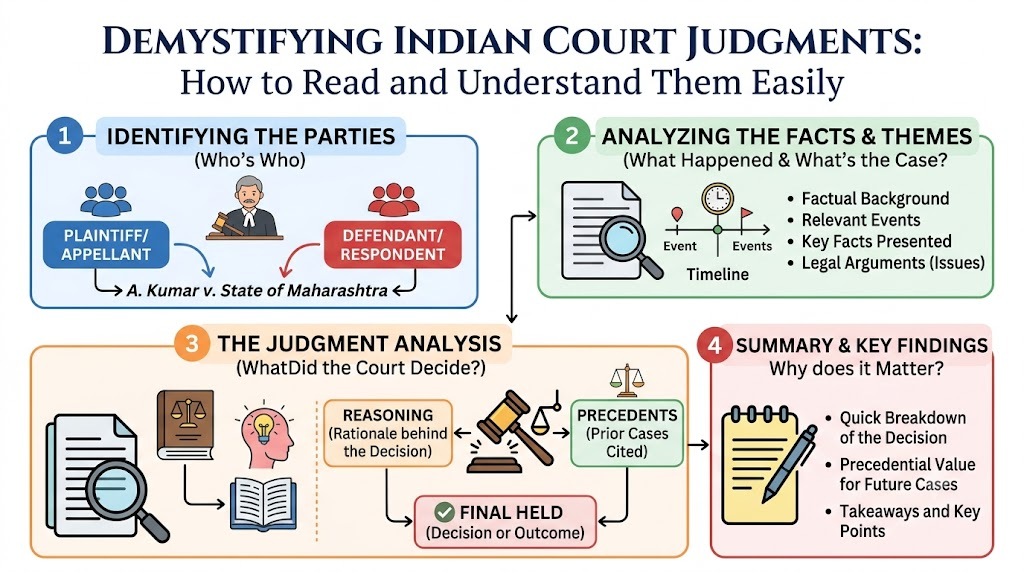
Although the document may look difficult to navigate, a structured reading method can help you cut through the complexity. By breaking down the judgment systematically, you can identify the main question, understand the important facts, and follow the court’s decision without feeling overwhelmed.
Reading the complete context is essential rather than relying solely on headlines, social media snippets, or short summaries. Headlines often simplify complex legal nuances or miss critical conditions attached to a ruling.
Fortunately, you do not need to understand every single legal citation immediately to begin following a court’s logic. By learning how judgments are organized, readers can explore Indian legal information with greater confidence. Platforms like WakilSahab.in offer legal resources that can help interested citizens stay informed about court judgment updates and legal discussions. Developing this foundational skill makes the law more transparent and accessible to everyone.
What Is A Court Judgment?
A court judgment is a formal judicial decision that explains how a court has resolved the issues it considered during a legal proceeding. It sets out the legal reasoning, the application of relevant laws to the facts of the case, and the final conclusions reached by the judges.
The exact form, length, and detail of a judgment depend heavily on the specific court, the nature of the case, and the applicable procedural rules. A routine matter may result in a short order or brief judgment, whereas a complex constitutional dispute may span hundreds of pages with detailed discussions on various legal principles.
It is important to understand that a judgment may resolve some core issues while leaving other procedural steps, calculations, or enforcement mechanisms for later consideration. Not every judgment contains the same headings or follows an identical format.
Appellate courts, trial courts, and specialized tribunals all structure their written decisions differently based on statutory requirements and judicial practice. Knowing what a judgment is helps set realistic expectations: it is a detailed record of judicial problem-solving rather than a simple yes-or-no answer.
Why Indian Court Judgments Can Be Difficult to Read
Indian court judgments often present a formidable challenge to readers who lack formal legal training. Several factors contribute to this complexity, including dense legal terminology, long factual histories, intricate procedural details, and statutory references.
Furthermore, a judgment typically includes citations to earlier cases, historical legislative context, and detailed submissions made by opposing counsels. One common point of confusion is that judgments frequently summarize the arguments presented by both sides before offering any evaluation.
Beginners often misread these descriptive passages as the court’s own conclusions. To read effectively, you must learn to distinguish between background information, party submissions, judicial analysis, and final directions. Recognizing these distinct blocks of text prevents you from mistaking an argument made by a lawyer for a rule established by the judge.
Understand the Basic Structure of a Judgment
While judgments vary in style, most well-drafted Indian court decisions share common structural elements. Readers typically encounter the court name, case title, case number, date, and the names of the judges forming the bench near the beginning of the document.
Following this introductory block, the judgment usually outlines the facts of the case, the questions raised, the arguments advanced by respective counsels, the legal analysis, and finally the concluding directions or relief granted.
These elements do not always appear under explicit headings, and different judges prefer distinct writing styles. However, understanding the typical flow makes navigation much easier.
For instance, the case title helps readers immediately identify the primary parties involved, such as an appellant and a respondent or a petitioner and the state. Recognizing these structural signposts allows you to skim efficiently and focus on the sections that matter most to your inquiry.
Start With the Case Name, Court, and Date
Before diving into the substantive arguments, you should always check which court delivered the judgment and when it was pronounced. The court’s identity determines its jurisdiction and the binding authority of its decision.
A judgment from the Supreme Court of India carries nationwide authority, whereas a decision from a specific High Court primarily binds subordinate courts within its territorial jurisdiction and offers persuasive value elsewhere.
Checking the date is equally crucial because the legal landscape changes rapidly through amendments and newer rulings. A judgment delivered decades ago may interpret a statutory provision that has since been modified or repealed. Verifying the case details against the official court source ensures that you are examining an authentic and up-to-date judicial record.
Find the Main Legal Issue
The legal issue is the core question or dispute that the court needed to resolve. Everything else in the judgment serves to answer this specific question.
When reading a judgment, you should look for explicit phrases such as “the question before the Court,” “the sole issue for consideration,” or similar framing language near the beginning of the analysis.
In some judgments, however, the legal issue is not introduced with a clear heading and must be inferred from the background facts and the arguments of the parties.
For example, in a property dispute, the broad disagreement might be over land ownership, but the precise legal issue might be whether a specific oral agreement is legally enforceable under the Transfer of Property Act.
Identifying this exact question keeps your reading focused and helps you evaluate how the court reached its conclusion.
Read the Important Facts First
Judgments usually dedicate a substantial portion of their opening pages to detailing the factual background. These facts include relevant events, dates, agreements, actions taken by the parties, and the history of how the dispute traveled from lower courts or tribunals up to the current forum.
While every detail in the background narrative has some relevance to the litigants, not all facts carry equal weight for the legal ruling. As you read, focus on the material facts—those specific occurrences without which the legal question would change.
Furthermore, remember that the factual summary often reflects the version established through evidence or accepted by the court, and you should avoid treating unproven allegations made by one party as established truths.
Understand the Arguments of Both Sides
Judgments meticulously record the submissions made by opposing counsels representing the petitioner, appellant, respondent, or state. Understanding these arguments is vital because the court’s reasoning responds directly to these competing viewpoints.
Counsel for the appellant will highlight statutory interpretations and precedents that favor their client, while the respondent’s counsel will present counter-arguments and alternative readings of the law.
Remember that summarizing an argument is merely part of the court’s duty to provide a fair hearing. A judge recounting an argument does not mean the court agrees with it.
Always look for the subsequent transition phrases—such as “However, we find merit in…” or “This submission cannot be accepted because…”—to see how the court evaluates these rival contentions.
Follow the Court’s Reasoning Step by Step
Judicial reasoning is the analytical bridge connecting the established facts and legal rules to the final outcome. This is the most educational part of any judgment.
In this section, the court evaluates the statutory provisions, examines relevant precedents, interprets legislative intent, and explains why specific arguments succeed while others fail.
To follow this step-by-step process, ask yourself three basic questions: What legal rule or principle did the court apply? How did the court connect that rule to the specific facts of the case? Why did the court reject alternative interpretations? Working through these questions helps you trace the logic of the judges without getting lost in lengthy legal prose.
Find the Final Decision and Directions
The concluding section of a judgment reveals the immediate outcome of the case. Common expressions found here include “appeal allowed,” “appeal dismissed,” “petition disposed of,” “matter remanded back to the trial court,” or specific “directions issued” to authorities.
It is vital to read these concluding paragraphs carefully alongside any conditions, timelines, or qualifications attached to the relief. For instance, a case being “disposed of” does not necessarily mean the petitioner won everything they asked for; it often means the court has concluded its current proceedings while issuing specific administrative or legal instructions that the parties must follow.
Understand Important Legal Terms in Plain Language
Legal documents use specialized vocabulary that can confuse beginners. Keeping a mental glossary of common terms makes reading much smoother.
- Judgment: The formal written decision containing the court’s reasoning and final conclusion.
- Order: A directional mandate issued by a court, which may address interim relief or final outcomes.
- Petitioner: The person or entity filing a petition or approaching the court for relief.
- Respondent: The opposing party called upon to answer the claims made by the petitioner.
- Appellant: A party who files an appeal against a lower court or tribunal decision.
- Precedent: An earlier judicial decision that serves as an authority for deciding subsequent cases with similar legal questions.
- Ratio decidendi: The binding legal reasoning or principle essential to the court’s decision.
- Obiter dicta: Judicial observations or remarks made incidentally that are not strictly necessary to decide the case.
- Appeal: A legal proceeding where a higher court reviews the decision of a lower court.
- Remand: Sending a case back to a lower court or authority for fresh consideration or further action.
- Interim relief: Temporary court orders granted while the main case is still pending.
- Final relief: The permanent remedy granted by the court at the conclusion of the case.
- Stay order: A judicial ruling halting execution of an order or staying ongoing proceedings.
- Disposed of: Indicates that the court has concluded its handling of that particular matter.
Understand Ratio Decidendi and Obiter Dicta
Not every sentence in a judgment carries the same legal weight. Legal systems distinguish between the core ruling and incidental remarks. The ratio decidendi represents the legal principle or rationale upon which the court’s decision is anchored. This is the portion of the judgment that acts as a binding precedent for future cases.
On the other hand, obiter dicta refers to statements, opinions, or observations made by a judge that go beyond what was necessary to resolve the immediate dispute.
While obiter remarks can offer valuable persuasive guidance and insight into judicial thinking, they do not constitute binding rules of law. Discerning the ratio from the dicta requires careful analysis of the core dispute and the exact legal rule applied.
Understand the Difference Between a Judgment and a Court Order
Readers frequently encounter the terms “judgment” and “order” used interchangeably in casual conversation, but they serve distinct functions within court proceedings.
A judgment provides a comprehensive explanation of the legal and factual reasoning behind a judicial decision, whereas an order is a formal command or direction issued by the court to effectuate that decision or manage procedural steps.
| Feature | Judgment | Court Order |
| General purpose | Explains a court’s decision and reasoning | Records a judicial direction or determination |
| Typical content | May discuss facts, issues, legal principles, and reasoning | May address a procedural issue, interim relief, or another matter |
| Timing | May be delivered at different stages, depending on the proceeding | May be issued during proceedings or at their conclusion |
| How to read it | Identify the issue, reasoning, findings, and final directions | Identify the direction, its scope, conditions, and duration |
| Important caution | Read the full decision and its context | Do not assume the order is temporary or final without checking its terms |
Note: The distinction depends on the document and legal context. This table is a general guide, not a rigid rule for every proceeding.
Learn How Precedents and Earlier Cases Are Used
Judges rarely decide cases in a vacuum; they rely heavily on legal precedents established by higher courts. When reading a judgment, you will notice references to earlier landmark cases, statutory interpretations, and established doctrines.
Judges examine these past rulings to maintain consistency and predictability in the legal system.
When a court distinguishes an earlier case, it explains why the facts or legal issues in the current dispute differ sufficiently to warrant a different outcome.
Paying attention to how precedents are applied helps you understand whether the law is being expanded, clarified, or applied in a standard manner.
How to Read Case Citations and Legal References
Case citations act as a precise addressing system for legal literature, allowing researchers to locate specific judgments quickly. A standard citation typically includes the names of the contesting parties, the volume number, the abbreviated name of the law report, the starting page number, and the year of the decision.
Modern judgments also incorporate neutral citations issued directly by courts along with specific paragraph numbers.
Learning to decode these abbreviations makes it much easier to verify references across different legal databases. Always copy citations carefully when conducting research to ensure you pull the exact document intended by the author or court.
How to Find Authentic Indian Court Judgments Online
Accessing authentic judicial records is easier today thanks to digital portals. The official website of the Supreme Court of India provides access to recent and landmark Supreme Court rulings.
Similarly, respective High Court websites maintain repositories of their own judgments and daily orders.
While third-party legal blogs and research platforms are helpful for discovering commentary and summaries, you should always cross-check critical legal details against official court sources.
WakilSahab.in serves as a supplementary legal information resource where readers can explore legal blogs and court judgment updates within its verified scope.
How to Check Whether a Judgment Is Still Good Law
A common mistake among beginners is treating any judgment found online as absolute, permanent law without investigating its subsequent history.
Legal decisions can be appealed, stayed, modified, reviewed, or overruled by a larger bench or a higher appellate court. Furthermore, legislative amendments can overturn the legal effect of a judicial ruling.
Before relying on a judgment for any important purpose, you must verify whether it remains good law.
Checking subsequent judicial treatment requires careful legal research and verification through reliable legal databases or consultation with qualified professionals.
Common Mistakes Beginners Should Avoid
Beginners often fall into several predictable traps when reading court documents. Avoiding these errors will significantly improve your comprehension:
- Reading only the headline or a short social media snippet without reviewing the context.
- Confusing a lawyer’s submission or argument with the actual finding of the court.
- Ignoring the final directions and operative part of the decision.
- Misinterpreting case citations or ignoring the date of the judgment.
- Assuming a ruling from one High Court automatically applies nationwide.
Keeping these pitfalls in mind ensures a more balanced and accurate understanding of judicial pronouncements.
A Simple Method for Summarizing a Judgment
To retain what you read, adopt a structured note-taking habit. When reviewing a judgment, record the following details:
- The name of the court and the date of the decision.
- A brief summary of the material facts.
- The precise legal issue framed by the court.
- The primary arguments raised by both parties.
- Key statutory provisions and precedents considered.
- The core judicial reasoning and ratio decidendi.
- The final decision, specific directions, and any relief granted.
How WakilSahab.in Can Help Readers Explore Indian Legal Information
WakilSahab.in offers legal resources designed for people interested in Indian law. The platform provides educational legal blogs, court judgment updates, lawyer discovery options, and legal discussions based on its published website features.
These resources can help interested individuals familiarize themselves with common legal terminology and explore general legal topics.
However, website summaries and articles should never be treated as official interpretations or substitutes for the original text of a judgment.
10 FAQs
1. What is a court judgment in simple language?
A court judgment is an official written decision by a judge or bench that explains the facts of a case, the legal issues involved, the reasoning behind the decision, and the final outcome.
2. How should a beginner start reading an Indian court judgment?
A beginner should start by checking the court name, date, and case title, then locate the background facts, identify the core legal issue, follow the court’s reasoning, and read the final directions.
3. What is the difference between a judgment and a court order?
A judgment provides a comprehensive explanation of the court’s legal and factual reasoning, while an order records a specific judicial direction or procedural mandate.
4. What does ratio decidendi mean?
Ratio decidendi refers to the binding legal reasoning or principle that forms the essential basis for the court’s decision in a case.
5. What is the meaning of obiter dicta?
Obiter dicta are incidental judicial remarks or observations made by a judge that are not strictly necessary to decide the core issue of the case.
6. How can I find Supreme Court and High Court judgments online?
You can find authentic judgments on the official website of the Supreme Court of India and the respective official portals of various High Courts.
7. How can I identify the final decision in a judgment?
The final decision is typically found in the concluding paragraphs, using terms like “appeal allowed,” “appeal dismissed,” or through specific directions issued by the court.
8. Does every High Court judgment apply across India?
No. A High Court judgment primarily binds courts within its own territorial jurisdiction and carries only persuasive value in other states.
9. How can I check whether a judgment has been overturned or modified?
You can check subsequent legal history by using reliable legal research databases to see if the ruling was appealed, stayed, or overruled by a higher bench.
10. Can a plain-language judgment summary replace the original judgment?
No. Summaries are helpful educational tools, but the original judgment remains essential when exact wording, precise legal effect, or official authority matters.
Legal Disclaimer
This article provides general legal information for educational purposes only. It does not constitute legal advice and does not replace consultation with a qualified advocate.
The legal effect of any judgment depends on its full text, relevant facts, applicable law, jurisdiction, and subsequent legal developments.
Read Court Judgments With Greater Clarity
Mastering how to read Indian court judgments is a valuable skill that bridges the gap between complex legal systems and everyday understanding. By identifying the court and date, separating material facts from background noise, following judicial reasoning step by step, and reading final directions carefully, readers can navigate legal documents with confidence.
Always verify important details against original court records and consult a qualified Indian advocate when a decision impacts your rights, property, or ongoing litigation. Explore educational resources on WakilSahab.in to continue expanding your knowledge of Indian legal information.
Conclusion
Understanding court judgments does not require a formal law degree, provided you approach each document with a structured and patient mindset. By systematically identifying the court, breaking down the facts, tracing the core legal issues, separating arguments from binding reasoning, and verifying subsequent history, anyone can grasp the practical meaning of a judicial ruling.
While summaries and plain-language guides serve as useful starting points, reading the full text ensures accurate comprehension when legal stakes are high. Utilizing trustworthy legal resources and knowing when to seek professional guidance empowers individuals to engage meaningfully with the Indian legal system. Explore further educational materials and updates on WakilSahab.in to continue your journey toward legal literacy and informed citizenship.